Resistance (2020) Review: A Powerful True Story of Courage That Struggles to Find Its Own Voice
Resistance (2020) tells the remarkable story of Marcel Marceau, the legendary mime artist whose talents extended far beyond the stage during World War II. Before becoming internationally celebrated for his silent performances, Marceau played a dangerous role in the French Resistance, helping Jewish children escape Nazi persecution. It is a deeply meaningful chapter of history, filled with courage, sacrifice, and humanity. Yet despite its compelling subject and a committed performance from Jesse Eisenberg, the film struggles to bring all its ambitions together, resulting in a moving but uneven historical drama.
Directed by Jonathan Jakubowicz, Resistance attempts to explore both the horrors of Nazi occupation and the extraordinary efforts of ordinary people who risked everything to protect others. While the film has several genuinely affecting moments, its crowded storyline and familiar wartime storytelling prevent it from reaching the emotional heights its subject deserves.
The Story: Marcel Marceau’s Journey From Performer to Resistance Fighter

Marcel Marceau (Jesse Eisenberg) begins his story as an aspiring actor working in a cabaret, where he develops his talent for entertaining audiences and bringing laughter to others. His ambitions, however, are not supported by his father, who wants him to follow the family trade as a kosher butcher.
Their disagreements soon become overshadowed by a far greater danger: the Nazi invasion of France.
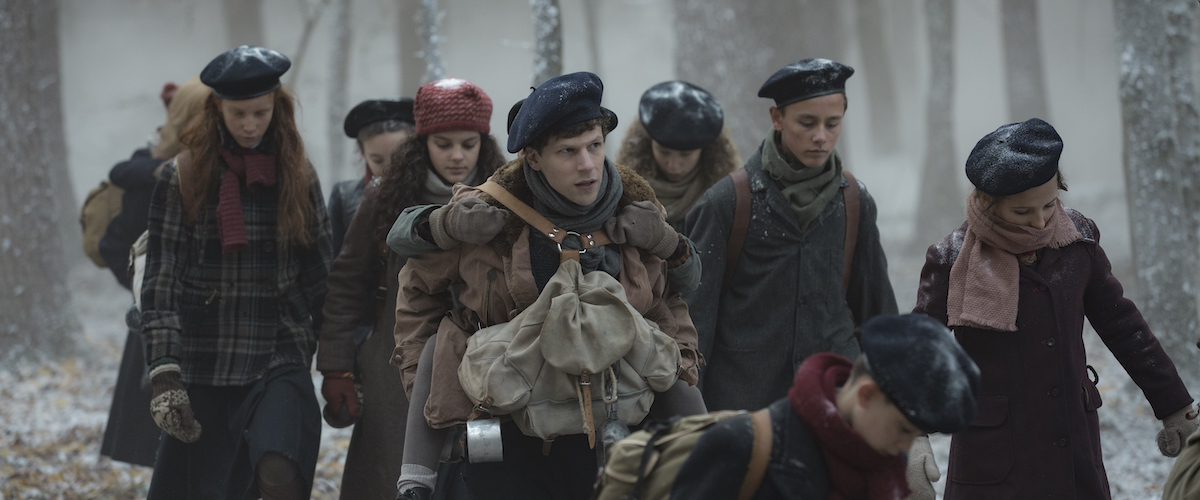
As the occupation intensifies, Marcel’s father is deported to Auschwitz, while Marcel becomes involved with the French Resistance. His decision is driven not only by a desire to fight against Nazi oppression but also by the need to protect a group of Jewish orphans whose lives are in immediate danger.
Drawing on his comedic abilities, Marcel uses humor and playful performances to comfort the children, offering them moments of happiness amid the surrounding fear and uncertainty. During this increasingly dangerous mission, he also grows closer to Emma (Clémence Poésy), an attractive fellow member of the Resistance.
Standing in their way is Klaus Barbie (Matthias Schweighöfer), one of the most notorious and ruthless Nazi figures in history. As Marcel and Emma attempt to move the children out of occupied France and into neutral Switzerland, they face escalating obstacles while Barbie and his forces work to stop their efforts and crush the resistance movement.
The Good: A Meaningful Story Anchored by Jesse Eisenberg
World War II has provided filmmakers with countless stories of extraordinary courage, particularly those surrounding the Holocaust and the suffering endured by Jewish communities under Nazi rule.
These films often explore the darkest aspects of human history while reminding audiences that compassion and bravery can survive even under the most horrific circumstances. Among the best-known examples are Schindler’s List, The Pianist, Life Is Beautiful, Defiance, The Boy in the Striped Pajamas, Woman in Gold, and The Zookeeper’s Wife.
For audiences familiar with this genre, Resistance enters an already well-established cinematic landscape. Its subject, however, offers a somewhat different perspective by focusing on Marcel Marceau, whose contribution during the war is less widely recognized than his later achievements as a performer.
Director Jonathan Jakubowicz, previously known for films such as Secuestro Express and Hands of Stone, takes on an ambitious project with Resistance. The film examines the cruelty of Nazi occupation without attempting to soften the reality of what Jewish people experienced during this period. Violence, persecution, and the constant threat of death are presented as central elements of the story.
Against this grim backdrop, Marcel becomes the film’s emotional center.
His ability to make children laugh, even when surrounded by suffering, provides an important contrast to the brutality unfolding around him. Rather than presenting him simply as another wartime hero, the film emphasizes how his artistic talents become a means of offering comfort and hope to those who have lost almost everything.
This is arguably the strongest aspect of Resistance. Marcel’s journey is fascinating, and the film succeeds in introducing audiences to a lesser-known chapter of his life. His determination to help others, combined with his willingness to place himself in danger, gives the story an emotional foundation that is difficult to dismiss.
The movie also benefits from its visual presentation. Jakubowicz creates a convincing wartime atmosphere through narrow European streets, residential neighborhoods, and carefully constructed period settings. The locations, production design, set decorations, and costumes contribute to an authentic sense of time and place, avoiding the inexpensive appearance that can sometimes undermine historical dramas.
Angelo Milli’s musical score provides additional emotional weight, supporting the film’s more dramatic sequences and reinforcing the contrast between the tenderness of Marcel’s interactions with the children and the violence surrounding them.
Although the film has several shortcomings, its central message remains worthwhile. Resistance reminds viewers that heroism does not always come from soldiers carrying weapons or commanding armies. Sometimes, it comes from people who use whatever abilities they possess to protect those who cannot protect themselves.
The Bad: An Overcrowded Story That Loses Its Direction

Unfortunately, the film’s ambitions also become one of its biggest weaknesses.
Rather than maintaining a consistent focus on Marcel’s transformation and his work with the French Resistance, the screenplay introduces numerous secondary storylines and supporting characters. These additional elements might have provided greater historical and emotional depth if they had been developed more carefully. Instead, they frequently distract from the central narrative.
Written by Jakubowicz himself, the screenplay takes several detours in its attempt to explore the different dimensions of the story. The result is a narrative that sometimes feels unnecessarily complicated, with important developments competing for attention.
A more concentrated approach, particularly one that followed Marcel’s personal journey more closely, could have given the film a much stronger emotional impact.
There is also a noticeable difference between the movie’s two halves. The first portion establishes one kind of story, while the second seems to move in a different direction. This shift makes the overall experience feel less cohesive than it should be.
The pacing suffers as a result. Some developments receive considerable attention, while others appear to move forward too quickly, leaving characters and relationships without enough time to develop naturally.
Jakubowicz’s direction also leans heavily on familiar conventions of Holocaust and World War II cinema. The suffering of Jewish families, the brutality of Nazi officers, the struggles of resistance fighters, and the determination to survive are all important elements of the historical setting.
However, these familiar themes are not always presented with enough originality to distinguish Resistance from the many films that have explored similar territory.
This does not make the movie ineffective or unwatchable. Its subject remains compelling, and its emotional moments are genuine. Nevertheless, the predictable storytelling and uneven structure prevent it from becoming a particularly memorable addition to the genre.
The Cast: Jesse Eisenberg Delivers the Film’s Most Memorable Performance

The performances are generally one of the film’s stronger elements, although the uneven character development prevents several members of the cast from making a lasting impression.
Leading the story is Jesse Eisenberg as Marcel Marceau. Known for his performances in Zombieland, Batman v Superman: Dawn of Justice, and The Social Network, Eisenberg has often played characters defined by a certain social awkwardness, nervous energy, and distinctive personality.
Those qualities make him an unexpectedly suitable choice for Marcel.
At first, seeing Eisenberg take on the lead role in such a serious World War II drama may seem like an unusual casting decision. However, he gradually makes the character his own, delivering a performance that balances emotional vulnerability with an endearing sense of humor.
His scenes with the children are particularly effective. Eisenberg captures Marcel’s ability to create moments of genuine happiness and reassurance, allowing the children to experience something resembling normal childhood despite the terrifying circumstances surrounding them.
These lighter interactions provide some of the film’s most touching moments. They also demonstrate why Marcel’s artistic abilities are so important to the story: laughter becomes more than entertainment; it becomes a way of helping vulnerable children cope with an uncertain future.
Eisenberg is equally convincing during the more dramatic portions of the film, conveying Marcel’s growing awareness of the dangers involved in his resistance activities.
Ultimately, his performance is one of the movie’s greatest assets and arguably its most memorable contribution.
Clémence Poésy, recognized for her appearances in Harry Potter and the Goblet of Fire and In Bruges, plays Emma, Marcel’s fellow resistance fighter and romantic interest. She brings a capable performance to the role, although the relationship between Emma and Marcel never develops the emotional depth needed to make their romantic connection particularly convincing.
Matthias Schweighöfer also makes an impression as Klaus Barbie, the ruthless Gestapo officer known by the nickname “The Butcher of Lyon.”
Schweighöfer effectively conveys the character’s cruelty and menace. His portrayal makes Barbie an intimidating presence whenever he appears on screen. However, the character sometimes feels as though he belongs in a different, more conventional World War II production rather than fitting naturally into the film’s central story.
The supporting cast is similarly talented but frequently underserved by the screenplay.
Félix Moati plays Alain, Vicka Kerekes appears as Mila, Géza Röhrig portrays Georges, and Bella Ramsey takes on the role of Elsbeth. Each actor brings something worthwhile to their respective character, but the crowded narrative leaves limited room for meaningful development.
As a result, many of these supporting figures become little more than secondary players who disappear into the background as the story moves forward.
Even Ed Harris, who portrays the historically prominent American military commander General George S. Patton, feels somewhat awkwardly incorporated into the overall narrative. Harris is certainly a suitable performer for such a recognizable historical figure, but his appearance does not feel as naturally connected to the rest of the film as it could have been.
The problem is not a lack of acting talent. Rather, the screenplay simply gives too many characters too little time to make a meaningful impression.
Final Thoughts: Worth Watching for Marcel Marceau’s Extraordinary Story

Resistance is a worthwhile historical drama built around a remarkable story of courage, compassion, and determination during one of humanity’s darkest periods.
Jonathan Jakubowicz brings Marcel Marceau’s lesser-known wartime experiences to the screen, highlighting how the entertainer’s talents became an unexpected source of comfort for Jewish children fleeing Nazi persecution. The film also captures the sacrifices involved in joining the French Resistance and the extraordinary risks people faced while attempting to save innocent lives.
Jesse Eisenberg delivers a strong central performance, supported by convincing production design, an appropriate musical score, and several genuinely moving moments.
However, the film never quite reaches its full potential. An overcrowded screenplay, underdeveloped supporting characters, familiar storytelling conventions, and inconsistent pacing prevent the different elements from coming together as effectively as they should.
For me, Resistance is a good film, but not a great one. Its historical subject is fascinating, its message is meaningful, and its emotional foundation is strong. Yet the execution feels too conventional and occasionally loses sight of the very story that makes the project worth telling.
My recommendation is “Rent It.” The film deserves at least one viewing, particularly for audiences interested in World War II history or those who want to learn more about Marcel Marceau beyond his celebrated career as a mime artist.
There are countless cinematic stories about the Second World War, many of them exploring the extraordinary courage of people who stood against Nazi oppression. Resistance may not rank among the most accomplished examples of the genre, but its central story remains important.
Ultimately, it is a film with a powerful message and a remarkable real-life figure at its heart. It simply tries to tell too many stories at once, leaving an otherwise compelling account of courage feeling somewhat lost within its own ambitions.