After my husband died, silence became the loudest sound in my life.
For forty-two years, Richard and I had shared the same home, the same routines, and the same dreams. When cancer took him away, every room suddenly felt too large. Every morning began with the painful realization that I would never hear his footsteps again.
A month after the funeral, my son Michael sat across from me at my kitchen table.
“Mom,” he said softly, “you shouldn’t be alone anymore. Come live with us. Rachel and I have plenty of room. The kids would love having Grandma around.”
Rachel smiled warmly.
“We’re family, Margaret. We’ll take care of you now.”
Those words touched my heart.
I sold my house, packed decades of memories into boxes, and moved into their beautiful suburban home, believing I wasn’t losing a home—I was joining one.
At first, it felt wonderful.
My grandchildren, Ethan and Lily, ran into my arms every afternoon after school. Rachel thanked me whenever I cooked dinner. Michael hugged me before leaving for work.
I felt needed.
I felt loved.
When Michael quietly admitted they were struggling with the mortgage, I didn’t hesitate.
“I still have savings,” I told him. “Your father worked hard for that money. He’d want it to help family.”
The first transfer was $150,000 toward the house.
“It isn’t a loan,” Michael insisted.
But I smiled.
“It doesn’t matter.”
Over the next several years, the requests became more frequent.
“We need new furniture.”
“The roof needs replacing.”
“The kids’ tuition has gone up.”
“Our credit cards are overwhelming.”
Every time, I wrote another check.
When Rachel admired a luxury dining set that cost nearly fifteen thousand dollars, I surprised her by paying for it.
When Michael worried about medical bills after Ethan broke his arm, I covered every dollar.
When the refrigerator failed.

When the washing machine broke.
When the car needed repairs.
When property taxes increased.
I paid.
Eventually, I stopped counting.
By then, nearly six hundred and eighty thousand dollars had quietly disappeared from my retirement savings.
I told myself it was worth it.
They’re my family.
What else is money for?
But something changed so gradually that I hardly noticed.
Rachel stopped asking whether I could babysit.
Instead, she simply announced their dinner plans.
“Margaret, we’re leaving at six.”
She no longer thanked me for cooking because somehow dinner simply appeared every evening.
Laundry became my responsibility.
Cleaning became expected.
School pickups.
Doctor appointments.
Birthday planning.
Holiday cooking.
I wasn’t a guest.
I wasn’t even family anymore.
I had become unpaid household staff.
One afternoon, I overheard Rachel talking on the phone.
“If Margaret moved into assisted living someday,” she laughed, “our expenses would actually go down.”
Her friend said something I couldn’t hear.
Rachel chuckled.
“Honestly, she’s cheaper than hiring a nanny.”
The words stung.
Still…
I stayed silent.
Because mothers forgive.
Or at least that’s what I believed.
Then Thanksgiving arrived.
It had always been my favorite holiday.
For three straight days, I prepared everything myself.
I baked pies from scratch.
Made cranberry sauce.
Prepared stuffing exactly the way Richard loved.
Brined the turkey overnight.
Even polished the silverware Rachel rarely used.
The grandchildren helped decorate the table.
Everything was ready.
That night, everyone seemed unusually cheerful.
“We’ll have an amazing Thanksgiving tomorrow,” Michael said.
“I can’t wait,” Ethan agreed.
Neither child seemed to know anything unusual.
I smiled.
“So can I.”
The next morning, I woke unusually late.
The house was silent.
I assumed everyone had gone shopping.
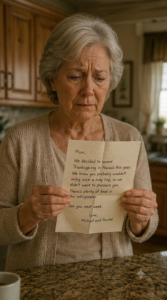
Then I noticed a folded piece of paper sitting on the kitchen counter.
My name was written across the front.
Mom,
We decided to spend Thanksgiving in Hawaii this year. We knew you probably wouldn’t enjoy such a long trip, so we didn’t want to pressure you. There’s plenty of food in the refrigerator.
See you next week.

Love,
Michael and Rachel
For nearly a full minute…
I simply stared.
Then I noticed another detail.
The refrigerator was almost empty.
The turkey was gone.
The pies were gone.
Even the leftovers I had prepared were gone.
Outside, the driveway was empty.
They hadn’t forgotten me.
They had planned this.
I sat alone at the dining table I had paid for.
Fourteen chairs.
Only one occupied.
For the first time in years…
I cried.
Not because I was alone.
Because I finally understood.
I wasn’t family.
I was convenient.
That afternoon, instead of feeling sorry for myself, I called my attorney.
His name was David Harper.
“I’d like to review every financial transfer I’ve ever made to my son.”
He remained quiet while examining years of records.
Finally he looked up.
“Margaret… several of these weren’t gifts.”
“They weren’t?”
“No.”
He pointed toward documents Michael himself had signed.
“These are legally documented loans.”
The total surprised even me.
Six hundred and seventy-nine thousand, eight hundred and forty dollars.
With interest…
The amount was even higher.
David looked directly at me.
“You have every legal right to demand repayment.”
I thought about Richard.
About the years we’d sacrificed.
About every vacation we skipped.
Every extra shift he worked.
Every dollar carefully saved.
Then I remembered eating Thanksgiving dinner alone.
“Prepare the paperwork.”
Over the next four days, I quietly rebuilt my life.
A moving company arrived while the house stood empty.
Every piece of furniture I had purchased was carefully removed.
The dining table.
The living room set.
The bedroom furniture.
Televisions.
Kitchen appliances.
Artwork.
Even the patio furniture.
Anything I had bought belonged to me.
Next, I canceled every automatic payment.
Utilities.
Insurance.
Internet.
Streaming services.
Cell phone plans.
Anything connected to my bank account disappeared.
Finally…
I signed legal documents demanding repayment of the mortgage loan.
Meanwhile, Michael and Rachel were sipping cocktails beside a Hawaiian beach.
Until Michael’s phone rang.
His smile disappeared.
“Our attorney just emailed us.”
Rachel frowned.
“What happened?”
He opened the document.
His face turned pale.
“Mom… wants nearly six hundred and eighty thousand dollars back.”
Rachel laughed nervously.
“She can’t be serious.”
Then Michael kept reading.
His hands began shaking.
“She’s serious.”
Within twenty-four hours, they ended their vacation early.
When they finally pulled into the driveway, Rachel screamed.
“The furniture!”
The house looked almost abandoned.
Rooms echoed.
Walls looked strangely empty.
The expensive dining room where Thanksgiving dinners had once been planned now contained nothing but bare hardwood floors.
Rachel burst into tears.
Michael wandered silently through room after room.
Everything was gone.
Then another envelope waited on the kitchen counter.
Legal notice.
Failure to repay would result in foreclosure proceedings.
Reality finally arrived.
That evening, Ethan quietly asked his father a simple question.
“Dad…”
“What is it?”
“Why did Grandma stay home?”
Michael hesitated.
“She didn’t want to travel.”
Lily frowned.
“That’s not true.”
Rachel froze.
“What do you mean?”
“I heard you talking before we left,” Lily whispered.
“You said Grandma would ruin the vacation because she’d make everyone feel guilty.”
Silence.
Ethan slowly looked at his parents.
“You lied.”
Neither child spoke for the rest of the evening.
Something far more valuable than furniture had disappeared.
Trust.
Over the following weeks, Michael finally examined every bank statement.
Every credit card.
Every loan.
Every payment.
A horrifying truth emerged.
Without his mother’s money…
They couldn’t actually afford their lifestyle.
Not the luxury vehicles.
Not the expensive schools.
Not the vacations.
Not even the house.
Everything had depended on Margaret.
One night he accidentally overheard Rachel speaking with her sister.
“If Margaret hadn’t changed,” Rachel complained, “eventually we’d inherit everything anyway.”
Her sister laughed.
Rachel answered coldly.
“Honestly, supporting her was just an investment.”
Michael felt sick.
Investment.
She wasn’t talking about a stranger.
She was talking about his mother.
That conversation ended his marriage.
Several months later, Michael filed for divorce.
The house was sold.
Most of the proceeds went toward repaying debts.
He moved with Ethan and Lily into a modest townhouse.
There were no luxury vacations anymore.
No expensive furniture.
No oversized mortgage.
Only honest living.
For the first time in years…
His paycheck actually reflected the life he lived.
As for me…
I bought a small cottage overlooking the ocean.
Every morning I watched the sunrise with a cup of coffee.
The furniture I’d reclaimed found new homes through local charities helping families who had lost everything in house fires and natural disasters.
Watching grateful strangers receive those things brought me more happiness than seeing them treated carelessly inside a mansion.
People often asked whether I hated my son.
Never.
Love doesn’t disappear.
But love without boundaries becomes permission for others to hurt you.
One year later…
Thanksgiving arrived again.
This time, Michael called weeks in advance.
“Mom… would you come if I cooked?”
“I’d like that.”
When I arrived, there was no mansion.
No designer furniture.
No extravagant decorations.
Just a warm little home filled with laughter.
Michael peeled potatoes.
Ethan set the table.
Lily baked pies beside me.
Everyone cleaned together.
No one expected one person to carry the entire holiday.
Before dinner, Michael stood.
His eyes filled with tears.
“Mom… I spent years thanking you with words while taking everything else for granted.”
He paused.
“I’m sorry for every check you wrote… every meal you cooked… every sacrifice I ignored.”
“I can’t change the past.”
“But I promise you’ll never have to earn your place in this family again.”
The room remained silent.
Then I walked over and hugged my son.
“I forgive you.”
“But forgiveness doesn’t erase lessons.”
He nodded.
“I know.”
And this time…
He truly did.
That Thanksgiving wasn’t perfect.
It wasn’t luxurious.
But for the first time in many years, it was honest.
Because family isn’t measured by the size of a house, the price of a vacation, or the value of an inheritance.
It’s measured by gratitude.
By respect.
By shared responsibility.
Kindness should never require someone to disappear.
Love should never demand endless sacrifice.
And the strongest families are not built on what one person gives—but on how everyone chooses to care for one another.