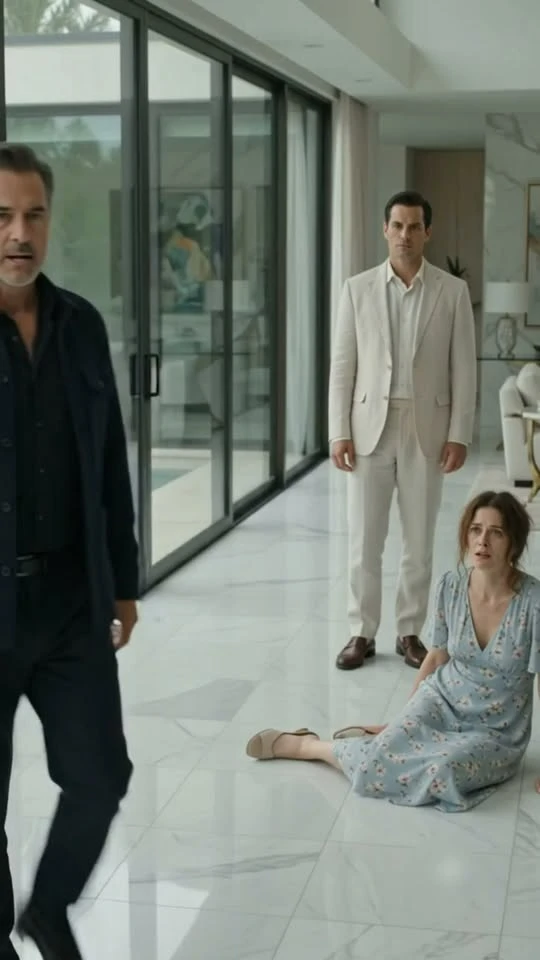
“Is Lily conscious?”
The voice on the satellite phone was calm, almost mechanical.
Arthur looked toward the passenger seat.
Lily sat curled against the door with both arms wrapped around her ribs. One eye was nearly swollen shut. Finger-shaped bruises darkened the skin around her throat.
“Yes,” Arthur said. “But she needs medical attention.”
“Are you still on Whitmore property?”
“Leaving now.”
“Do not use the local hospital. Do not contact local police. Drive north on County Road Nine. You will receive coordinates in thirty seconds.”
The line went silent.
Arthur placed the satellite phone on the dashboard and started the truck.
Richard remained on the mansion steps, surrounded by relatives, business partners, and neighbors who had spent years laughing at his jokes and accepting his invitations.
His smile had vanished.
He recognized neither the phone nor the identification card Arthur had used.
But he recognized authority when he heard it.
“Arthur!” Richard shouted. “You take her off this property, and I’ll have you arrested before you reach the highway.”
Arthur lowered the passenger window.
Lily flinched at the sound of Richard’s voice.
Arthur saw it.
So did everyone else.
He looked directly at his son-in-law.
“You should be more worried about who reaches you first.”
Then he drove away.
The iron gates opened slowly.
For one terrifying second, Arthur expected Richard’s security men to block the road.
They did not.
They had seen Lily’s face.
They had heard the phone call.
And unlike Richard, they were beginning to understand that wealth could protect a man only while everyone around him agreed to remain silent.
Arthur turned onto the main road.
Lily stayed motionless until the mansion disappeared behind the trees.
Then she whispered, “He’ll tell them I was drunk.”
“I know.”
“He’ll say I fell.”
“I know.”
“The police chief eats dinner at his restaurant every Thursday.”
“I know that too.”
She turned toward him with her uninjured eye.
“How?”
Arthur gripped the steering wheel.
Because he had made a mistake long before that Easter Sunday.
He had mistaken Lily’s silence for happiness.
When she stopped calling as often, he told himself she was busy.
When she wore long sleeves in warm weather, he believed her explanation about the air-conditioning.
When she defended Richard too quickly, Arthur assumed marriage required compromises he no longer understood.
He had seen the warning signs.
He simply had not wanted to name them.
“I should have asked better questions,” he said.
Lily stared through the windshield.
“He was nice at first.”
Arthur said nothing.
“He remembered everything. My coffee order. My birthday. Mom’s name. He made me feel like I was the only person in every room.”
Her voice shook.
“Then he started correcting me. How I dressed. Who I spoke to. How long I stayed at the grocery store. He said it was because people were watching him.”
Arthur glanced at her.
“Did he hurt you before today?”
She did not answer.
That was an answer.
The satellite phone chimed.
Coordinates appeared on the small green screen.
Arthur followed them to an abandoned agricultural airstrip eleven miles north of town.
A white medical helicopter was already waiting.
Beside it stood a woman in a navy field jacket, her dark hair streaked with gray.
Lily looked at Arthur.
“Who is she?”
“Someone I used to trust with my life.”
The woman approached as soon as the truck stopped.
Her name was Evelyn Shaw.
Twenty years earlier, she and Arthur had served together in a federal task force that tracked financial networks connected to organized crime, political corruption, and private security contractors.
Arthur had not carried a weapon in fifteen years.
He had not used an encrypted line in twelve.
But Evelyn still moved like someone who noticed every hand, every window, and every approaching vehicle.
She opened Lily’s door carefully.
“My name is Evelyn. I’m not local law enforcement. I’m here to get you somewhere safe.”
Lily looked at Arthur before allowing Evelyn to help her out.
A medical team photographed every visible injury before touching anything.
They documented the bruises around Lily’s throat.
The split lip.
The swelling along her ribs.
The blood beneath her fingernails.
One of the medics asked if she had scratched Richard while defending herself.
Lily nodded.
“Good,” Evelyn said quietly. “That may matter later.”
Arthur followed them into the helicopter.
As it lifted, he watched the town shrink beneath them.
Richard had once told Lily that no one outside Whitmore County cared what happened there.
By late afternoon, people far outside the county were already listening.
The helicopter took them to a private trauma center across the state line.
The facility did not notify Whitmore police.
It contacted a state-level special victims investigator, a federal prosecutor, and an independent forensic nurse.
Lily’s injuries were examined, measured, photographed, and recorded.
Every piece of clothing was sealed.
Every statement was timestamped.
Arthur remained beside her until the nurse asked to speak with Lily alone.
He waited in the hallway with Evelyn.
“You said code black,” she said.
“I meant it.”
“That phrase activates everything.”
“I know.”
“Financial review. Communication recovery. Protective custody. Federal notification.”
“I know.”
Evelyn studied him.
“You disappeared from this world for a reason.”
“My daughter called me while her husband was beating her.”
“That is not what I asked.”
Arthur looked through the narrow window in Lily’s door.
“I disappeared because I thought the work had already taken enough from my family.”
His wife, Margaret, had died believing Arthur’s old life was behind them.
Lily had been ten years old the last time he used the satellite phone.
That was when a protected witness connected to one of Arthur’s investigations had vanished.
Arthur resigned three weeks later.
He bought a small house outside town.
He repaired machinery.
He attended Lily’s school events.
He tried to become ordinary.
But he kept one emergency box beneath the truck’s dashboard because experience had taught him something peace never could:
Powerful men rarely stop being dangerous simply because no one is looking.
Evelyn handed him a tablet.
“We recovered the call.”
Arthur looked at the screen.
Lily’s phone had fallen beneath a sofa during the assault. The call had remained active for six minutes and forty-three seconds.
The recording captured Richard shouting.
Lily crying.
Furniture striking the floor.
Several guests asking him to stop.
And Richard saying something he could never explain away.
“You belong to me. Your father can’t save you. I own every badge in this county.”
Arthur listened once.
Then he removed the headphones.
“There were witnesses.”
“Fourteen confirmed so far.”
“Will they speak?”
“Some already have.”
Arthur looked at her.
“That quickly?”
“One of them sent us a video before your helicopter landed.”
Evelyn opened another file.
The footage had been recorded through the gap between two guests standing near the dining room.
Richard was visible gripping Lily by the throat.
His free hand was raised.
Several people stood around him.
No one moved.
Then one woman stepped forward.
Richard’s sister.
She tried to pull him away.
He shoved her into a table.
The video ended when the person recording lowered the phone.
Arthur’s hands began to shake.
Evelyn took the tablet from him.
“Do not confuse control with calm,” she said. “You are allowed to feel this.”
“I promised Lily he would never touch her again.”
“Then help us build something stronger than a promise.”
At 5:18 that evening, Richard Whitmore entered the local police station voluntarily.
His attorney walked beside him.
The police chief met them personally at the entrance.
Richard expected to file a kidnapping complaint against Arthur.
Instead, two investigators from the state attorney general’s office were waiting inside.
The police chief tried to object.
One of the investigators handed him a sealed order.
The chief read the first page and stopped speaking.
Richard’s attorney demanded to know the allegations.
The investigator listed them without emotion.
Domestic assault.
Strangulation.
Witness intimidation.
Evidence tampering.
Conspiracy to obstruct justice.
Possible misuse of public officials.
Richard laughed at the last charge.
It was the wrong response.
Because while the medical team documented Lily’s injuries, Evelyn’s unit had begun following the money.
Richard’s restaurants had hosted hundreds of “private community dinners” over the previous six years.
Local officials attended without paying.
Police vehicles received free fuel through a company owned by Richard’s cousin.
A judge’s son had been given a management position despite never reporting for work.
Campaign donations moved through employee names before reaching the same city council members who approved Richard’s construction projects.
None of it had begun with Lily.
She was simply the first person close enough to Richard to expose how he treated anyone who believed they could say no.
At the trauma center, Lily finished giving her statement shortly after sunset.
Arthur was allowed back into the room.
She looked exhausted.
Smaller than she had that morning.
But something in her face had changed.
Fear was still there.
So was shame, although none of it belonged to her.
Beneath both was anger.
“Did they believe me?” she asked.
“Yes.”
“All of it?”
“Yes.”
She looked down at the blanket.
“Richard always said I sounded unstable when I cried.”
“Crying does not make the truth less true.”
“He’ll find a way out.”
“Maybe.”
Arthur sat beside her.
“But getting out of one room is not the same as escaping every consequence.”
Lily studied him.
“Who are you?”
The question hurt more than he expected.
“I’m your father.”
“You know what I mean.”
Arthur looked toward Evelyn, who stood near the door.
Then he told Lily the truth.
He explained the task force.
The investigations.
The witnesses he had protected.
The encrypted network.
The reason the black box had remained hidden for so long.
Lily listened without interrupting.
When he finished, she asked, “Did Mom know?”
“Yes.”
“Why didn’t you tell me?”
“Because I wanted you to have a life untouched by any of it.”
Lily gave a tired, bitter laugh.
“That worked well.”
Arthur lowered his head.
“You’re right.”
She reached for his hand.
“I’m still glad you came.”
At 8:41, Evelyn entered carrying a printed report.
“Richard has been detained pending a hearing,” she said. “His passport has been flagged. The state has also suspended the local chief’s access to the evidence system.”
Lily closed her eyes in relief.
Arthur noticed that Evelyn did not look relieved.
“What else?” he asked.
She placed the report on the table.
“The assault recording was not the only file recovered from Lily’s phone.”
Lily opened her eyes.
“What file?”
“A synchronized cloud folder connected to Richard’s home network.”
Lily frowned.
“I didn’t create one.”
“No,” Evelyn said. “Richard did.”
The folder contained audio recordings from inside the mansion.
Hundreds of them.
Business meetings.
Conversations with officials.
Threats against employees.
Payments discussed openly because Richard believed everyone in the room belonged to him.
One recording had been made three nights before Easter.
Richard was speaking with the police chief.
Arthur read the transcript.
The chief warned Richard that Lily had contacted a divorce attorney.
Richard responded that she would not be leaving with any money, property, or credibility.
Then he said:
“If she runs to her father, we deal with him the same way we dealt with Margaret.”
Arthur stopped breathing.
Lily looked at him.
“Mom?”
Evelyn’s voice softened.
“Arthur, Margaret’s death may not have been the accident you were told it was.”
The room seemed to tilt.
For nine years, Arthur had believed his wife died after losing control of her vehicle on a rain-slick road.
There had been no witnesses.
The responding officer was now the Whitmore police chief.
The towing company belonged to Richard’s uncle.
And the original crash photographs had disappeared from the county archive.
Arthur looked at Lily.
She had just escaped one nightmare.
He could not let his anger drag her into another.
So he did not shout.
He did not threaten Richard.
He did not reach for the satellite phone.
He placed both hands flat on the table and asked Evelyn the only question that mattered.
“Can you prove it?”
“We can reopen it.”
“That isn’t what I asked.”
Evelyn met his eyes.
“Give me forty-eight hours.”
Arthur nodded.
Across town, Richard sat in an interview room, still insisting that his name could end the investigation.
At 9:07, an investigator placed a photograph of Margaret Miller’s wrecked car on the table.
Richard stared at it for less than a second.
But the camera caught everything.
The sudden tightening of his jaw.
The recognition in his eyes.
And the first unmistakable trace of fear.
For the second time that Easter Sunday, Richard Whitmore stopped smiling.
This time, he understood why Arthur had said to burn everything down.
Arthur had not ordered anyone to destroy the town.
He had ordered them to remove every layer of protection beneath Richard’s feet.
And before morning, the entire Whitmore empire would begin collapsing under the weight of its own recordings.