The officer kept the document inside the clear evidence sleeve and looked at Jason for several seconds before saying anything.
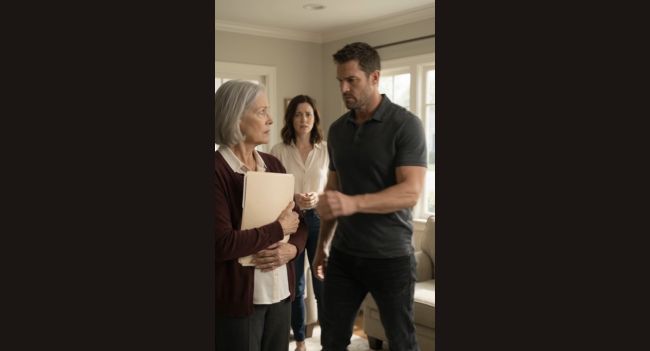
“Then you can explain why this signature doesn’t match hers.”
Jason’s mouth opened, but no sound came out.
Megan stood a few feet away with her arms folded tightly across her chest.
Until that moment, she had looked angry more than frightened.
Now the color left her face.
I was still sitting on the edge of the lawn while a paramedic examined the swelling along my cheek and the scrape on my arm.
Every breath hurt where I had struck the concrete, but the pain seemed distant compared with what I had just heard.
“What signature?” I asked.
The officer glanced toward me.
“Ma’am, we’ll let the investigators sort out exactly what this document is.
For now, can you tell me whether you signed anything recently giving your daughter or son-in-law authority over an insurance payment?”
“No.”
The word came out immediately.
Megan finally spoke.
“Mom, don’t do this here.”
I looked at her.
My daughter had just watched her husband punch me.
She had dragged me across her floor by my hair.
She had thrown me onto concrete and told me I would never see a dollar of money she apparently believed belonged to her.
And she was still worried about where the conversation was happening.
“You already did this here,” I said.
The neighbor holding the phone lowered it slowly.
Mrs.
Alvarez remained beside me, one hand resting on my shoulder.
The officer holding the evidence sleeve asked Jason to turn around.
Jason’s confidence returned for half a second.
“You’re arresting me because of a family argument?”
“I’m detaining you while we investigate an assault witnessed by multiple people and recorded on video.
Put your hands behind your back.”
Jason looked toward Megan as though he expected her to fix the situation.
She couldn’t.
The handcuffs closed around his wrists.
That sound changed everything.
Megan stepped forward.
“He was protecting me.
She came into our house screaming.”
Three neighbors spoke almost at once.
“That’s not what happened.”
“She wasn’t screaming.”
“We saw you drag her outside.”
Megan stopped.
The officer took statements while paramedics helped me onto a stretcher.
Before they moved me toward the ambulance, I asked for my folder.
The officer shook his head gently.
“We need to hold the documents for now.
You’ll receive a property receipt.”
I nodded.
For weeks, Megan had pressured me to sign forms connected to a three-million-dollar insurance benefit created after her father’s death.
My husband had spent decades building a small manufacturing company, and after he died, several policies and investment accounts were reorganized.
Most of the money had never belonged directly to Megan or Jason.
It was held under arrangements designed to provide for me first, with whatever remained eventually passing to our children.
Megan knew that.
What I had not understood was how desperately she wanted that order reversed.
Her calls had become more frequent over the previous month.
“It’s just administrative,” she had told me.
Then, “The company needs updated signatures.”
Then, “Jason understands this stuff better than you do.”
I had nearly signed the packet she emailed me.
Something stopped me.
One section referred to a transfer I did not recognize.
Another page listed Jason
as an authorized representative even though I had never appointed him.
So instead of signing, I called the insurance company directly.
A representative told me not to alter anything until I received a complete copy of the file.
That was the paperwork I had brought to Megan’s house.
Inside it was a notice confirming that I remained the sole person authorized to make changes to the account.
There was also a copy of a recent request—submitted in my name—to redirect the proceeds.
I had not made that request.
At the hospital, doctors confirmed that I had a concussion, bruised ribs, and several cuts but no internal bleeding.
Mrs.
Alvarez stayed until my sister arrived.
Megan sent six messages while I was being examined.
The first said, “Please don’t make this worse.”
The second said, “Jason lost his temper, but you provoked him.”
The third said, “We can fix this as a family.”
By the sixth message, the tone had changed.
“Do NOT speak to the insurance company until we talk.”
I showed the messages to my sister.
She read them twice.
“Save everything,” she said.
I did.
The next morning, a detective called me.
The neighbor’s video was clearer than anyone had expected.
It captured Jason punching me through the open doorway.
It showed Megan pulling me across the threshold.
It recorded her saying, “It’s three million,” before telling me I would not receive a dollar.
Most importantly, the video caught Jason handling my documents.
As Megan dragged me outside, several papers had spilled from the folder.
Jason picked them up, scanned one page, looked sharply toward Megan, then folded a document and carried it back into the house.
Police found that document behind a couch cushion.
It was a beneficiary-change request.
My name appeared at the bottom.
So did a signature that looked like mine from a distance.
It was not mine.
The detective asked whether I had ever signed a document transferring control of the policy or naming Jason as my representative.
“Never.”
“Did you give either of them permission to sign for you?”
“No.”
“Did they have access to examples of your signature?”
That question hurt in a different way.
Of course they did.
Megan had helped me with Christmas cards.
She had copies of old tax documents.
She had handled paperwork after her father died.
There were dozens of places she could have seen my signature.
I told the detective that.
He was quiet for a moment.
“We’ll need records from the insurer.”
The insurance company froze all requested changes as soon as investigators contacted it.
Then their fraud department began reviewing the file.
Within days, the situation expanded far beyond the assault on the porch.
Investigators found that someone had created an online account using my personal information.
The contact email was not mine.
The phone number attached to the account belonged to a prepaid device.
Several change requests had been submitted over a six-week period.
One attempted to name Megan as the controlling recipient of the three-million-dollar benefit.
Another sought authority for Jason to communicate on my behalf.
Both relied on copies of identification and documents that appeared to have come from files stored in my home.
I remembered something then.
Two months earlier, Megan had offered to “organize” the paperwork in my study.
She spent almost an entire afternoon there while I made lunch downstairs.
At the time, I had been grateful.
Now I felt sick.
The detective asked whether anything had disappeared.
I searched my cabinets and found an old folder missing—the one containing copies of my driver’s license, Social Security card, and several signed financial forms.
I sat on the floor of my study after discovering the empty space on the shelf.
For the first time since the attack, I cried.
Not because of the money.
Because I remembered Megan at eight years old asleep against my shoulder during thunderstorms.
Megan at sixteen calling me from a school dance because she wanted to come home.
Megan standing beside me at her father’s funeral, gripping my hand so tightly that our fingers hurt.
I could understand greed in the abstract.
I could not understand how my child had turned me into paperwork.
Three days later, Megan arrived at my house.
My sister was staying with me, and she saw Megan through the window before I did.
“Don’t open the door,” she said.
Megan rang the bell repeatedly.
Then she knocked.
“Mom, please.
I just want to talk.”
I stood several feet from the door.
“You can talk to my lawyer.”
Silence.
Then Megan’s voice changed.
“A lawyer? You’re really doing this to me?”
I almost laughed at the cruelty of the question.
I opened the inner door but kept the storm door locked.
She stared at the bruising on my face and looked away.
“Jason is facing charges,” she said.
“He could lose his job.”
“He punched me.”
“He panicked.”
“You dragged me by my hair.”
Megan pressed her lips together.
“I was upset.”
“You threw me onto the porch.”
“I said I was upset.”
I studied her face.
There was no apology in it.
Only fear.
“Who signed my name?” I asked.
Her eyes shifted.
That was enough.
“Mom—”
“Who signed it?”
“Jason handled the paperwork.”
“Did you know?”
She looked toward the driveway.
“We were trying to protect what Dad wanted us to have.”
There it was.
Not denial.
Just justification.
“Your father wanted me protected,” I said.
“That’s why the policy was structured that way.”
“You don’t need three million dollars.”
The sentence landed harder than I expected.
“Neither do you.”
Her face hardened.
“We have debts.”
I had suspected that much.
Jason liked expensive cars, expensive vacations, expensive watches, and the appearance of effortless success.
Their house was larger than either of them needed.
Social media showed restaurants, resorts, and carefully framed photographs of a life that looked untouchable.
What it did not show was the truth.
Investigators eventually found it anyway.
Jason’s business had been struggling for more than a year.
He had personally guaranteed loans.
Credit cards were near their limits.
Their mortgage had been refinanced twice.
One lender was already threatening legal action.
The three million dollars had become their imagined escape route.
And I had become the obstacle.
Megan gripped the storm-door handle.
“If you keep pushing this, everything will be destroyed.”
“You mean everything you built.”
She stared at me.
“Think about what people will say.”
That sentence finally made something inside me settle.
Even then, she was worried about appearances.
Not my injuries.
Not the forged signature.
Not what she had done.
The neighbors had watched her drag her mother by the hair, and Megan’s greatest fear was embarrassment.
“I think people already saw enough,” I said.
Then I closed the door.
My lawyer sent formal notices preventing Megan or Jason from acting on my behalf in any financial matter.
The insurer confirmed in writing that no transfer had been completed and that the three-million-dollar benefit remained under the original arrangement.
The forged request had failed.
But the investigation continued.
Jason initially claimed I had signed the forms and forgotten.
Then he claimed Megan had given him permission.
Then he said an outside financial adviser had prepared everything.
Each version created a new problem because records contradicted him.
The prepaid phone used for account verification had connected repeatedly to the Wi-Fi network inside Megan and Jason’s home.
A scanned copy of my identification was found on Jason’s laptop.
Draft versions of the beneficiary form were recovered as well.
One file contained three different attempts to imitate my signature.
When detectives confronted him with that, Jason stopped answering questions.
Megan tried to separate herself from him.
She told investigators she had believed the paperwork was legitimate.
Then police obtained messages between them.
One from Jason read, “She won’t sign willingly.”
Megan had replied, “Then stop asking her.
Just finish it.”
Another message, sent the morning I came to their house, said, “Make sure she brings the originals.”
That message ended any possibility that I could explain her behavior away as panic or confusion.
She knew.
The criminal case moved slowly, as criminal cases often do.
Jason faced charges related to the assault and the alleged fraudulent documents.
Megan faced her own charges stemming from the attack and the financial scheme.
Their lawyers challenged evidence, argued over intent, and tried to portray the confrontation as a chaotic family dispute.
The video made that difficult.
At a preliminary hearing, I sat behind the prosecutor while the neighbor’s recording played in court.
I had avoided watching it until then.
Seeing myself fall was worse than remembering it.
Jason’s punch looked shockingly casual.
Megan’s hand closed around my hair almost immediately afterward.
There was no hesitation on her face.
Then came her voice through the phone’s tiny speaker.
“It’s three million.
Jason and I are done asking.
You are not getting a single dollar.”
The courtroom became completely still.
Megan stared at the table.
Jason did not look at me.
The prosecutor froze the video at the moment Jason bent to pick up the scattered documents.
Then she showed the recovered beneficiary form.
Then the account records.
Then the text messages.
The story they had tried to tell—that I was confused, that I had fallen, that the documents were ordinary family paperwork—collapsed one piece at a time.
Months later, the cases ended without the dramatic spectacle people sometimes imagine.
There was no shouting verdict, no cinematic confession.
There were lawyers, negotiated pleas, restitution provisions, protective orders, probation conditions, and consequences that followed them into ordinary life.
Jason lost his position after his employer learned of the case.
Their lender moved forward on debts they could no longer hide.
The large house was eventually placed on the market.
Megan was ordered to stay away from me except through attorneys while the case was active.
The three million dollars
never became theirs.
I changed every account password I had.
I moved important documents into a safe-deposit box.
I appointed an independent professional to help manage the insurance and estate paperwork so no family member could quietly insert themselves again.
And I changed my will.
That was the decision people asked me about most.
Some thought I should forgive Megan immediately because she was my daughter.
Others thought I should cut her off forever.
Neither group had been on the tile floor looking up at their own child while she chose money over them.
I did not make the decision out of revenge.
I made it because trust has consequences when it exists, and consequences when it is destroyed.
Nearly a year after the attack, I saw Mrs.
Alvarez outside my house carrying a small pot of flowers.
She had become more than a neighbor by then.
She was the person who ran toward me when my own family pushed me away.
We sat together on my porch.
For a while, neither of us mentioned Megan or Jason.
Then Mrs.
Alvarez said, “I still think about that day.”
“So do I.”
“You know what I remember most?”
I expected her to mention the punch, the shouting, or the police cars.
Instead she said, “The moment Jason told all of us to go home.
He really thought everyone would obey him.”
I smiled for the first time while talking about it.
That was true.
Jason and Megan had built their entire plan around silence.
They expected me to be frightened, embarrassed, and too emotionally tangled to resist.
They assumed neighbors would call it a private family matter.
They assumed paperwork could be changed before anyone looked closely.
They assumed three million dollars gave them a reason powerful enough to excuse whatever they did to reach it.
They were wrong because one neighbor recorded what he saw.
Another called 911.
An officer noticed a folder.
An investigator questioned a signature.
And eventually, every quiet piece of evidence began speaking at once.
I still have scars from that afternoon, though most are no longer visible.
Megan has written to me since the protective order ended.
Her first letters contained explanations.
Later ones contained apologies.
I have read them, but I have not answered all of them.
Forgiveness, I learned, is not the same thing as access.
I can hope my daughter becomes someone who understands what she did without handing her the keys to my life again.
The folder that started everything is back in my possession now.
For months, I hated looking at it.
Eventually I placed it in the safe with the rest of my records.
On top is the property receipt the police gave me that Sunday afternoon.
It reminds me of something I almost forgot while lying on the concrete outside my daughter’s house.
They believed I had nothing because I was injured, shocked, and alone.
But I was never as alone as they thought.
There were witnesses.
There was evidence.
There was a record of the truth.
And when the moment came, that was worth far more than the three million dollars they were willing to destroy a family to take.