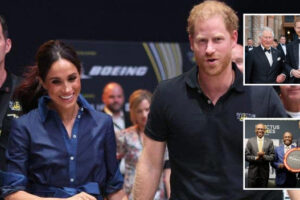
Uganda’s sudden withdrawal from Prince Harry’s Invictus Games has opened a new and unexpected dispute over Buckingham Palace’s recent clarification of the Duke and Duchess of Sussex’s royal status.
A source close to Prince Harry has arg
ued that the decision is a consequence — whether intended or not — of guidance issued by the Lord Chamberlain on King Charles’s behalf earlier this week. The Palace letter formally reiterated that Harry and Meghan remain non-working members of the Royal Family despite moving back to Britain.
Uganda’s military chief, Gen Muhoozi Kainerugaba, meanwhile, framed the withdrawal around his support for the King, saying his country would not participate in something he believed did not have Charles’s approval.
There is, however, no evidence that King Charles asked Uganda to withdraw or that he opposes the Invictus Games. The King attended the inaugural Games in 2014, and a senior royal source has stressed that he supports organisations helping wounded service personnel.
Harry source points to Palace letter

The controversy comes just days after Buckingham Palace took the unusual step of publicly clarifying Harry and Meghan’s position following their return to Britain.
The guidance, sent by the Lord Chamberlain to government and military offices as well as Lord Lieutenants, reaffirmed that the Sussexes are not working royals and cannot use their HRH styles. Their charitable activities are undertaken in a private capacity, while they are described as private citizens with commercial interests.
The Sussex camp was caught off guard by the public release.
Against that backdrop, a source close to Harry has now linked the timing of the Palace intervention with Uganda’s decision to leave Invictus.
“Intended or unintended, this is clearly a consequence of the Lord Chamberlain’s guidance regarding the Duke and Duchess of Sussex, that was rushed out without consultation on Monday,” the source said.
The source added that the competitors would ultimately be the ones affected by the fallout.
The Invictus Games Foundation has also reportedly been told that the Palace guidance created some “confusion” within Uganda’s defence establishment.
Still, the precise reason for Uganda’s interpretation remains uncertain.
When asked for clarification, Ugandan government spokesman Alan Kasujja said Kainerugaba speaks for the Uganda People’s Defence Forces and that, unless his position changes, it should be regarded as the military’s position. Kasujja said he did not know why the withdrawal had been made or whether the Palace letter directly prompted it.
Uganda military chief makes allegiance to Charles clear

Kainerugaba, who is also the son of Uganda’s president, announced the decision publicly.
“In order not to be construed as being opposed to His Majesty King Charles III of the United Kingdom, whom we deeply revere, Uganda hereby withdraws from the Invictus Games,” he wrote.
“We shall not participate in anything that does not have His Majesty’s approval.”
Speaking separately about his decision, Kainerugaba was even more direct about where his loyalties lay.
“I have factions in the Ministry of Defence that support that Harry-Meghan nonsense. I had to quash it straight away. I support the monarch. Period.”
His comments are particularly striking because Uganda had only recently joined the Invictus community.
Harry personally welcomed the country in London in July, when Uganda became the newest nation to join the movement.
Its departure therefore represents an unexpected reversal ahead of the Birmingham Games.
Palace guidance followed Sussex return to Britain

The disagreement cannot be separated from the wider debate surrounding Harry and Meghan’s move back to the UK.
Their return did not restore their former royal roles.
When news of the relocation emerged in August, it was already understood that Charles welcomed the opportunity to see more of Harry, Meghan, Archie and Lilibet privately, while remaining clear that the couple’s official position had not changed. They would continue as non-working members of the Royal Family.
The Lord Chamberlain’s subsequent guidance made that distinction more formal.
Harry and Meghan cannot use their HRH styles, do not represent the sovereign when undertaking public appearances and carry out charitable work in a private capacity.
According to the Palace, the purpose was straightforward: government departments, military organisations and Lord Lieutenants needed clarity now that the Sussexes were once again living in Britain.
But the timing and public nature of the letter surprised Harry’s team.
That reaction has now taken on greater significance following Uganda’s announcement.
No evidence Charles opposes Invictus
One distinction remains crucial.
Kainerugaba’s statement suggests that he regarded participation in Invictus as potentially conflicting with his support for Charles. But there is no indication from Buckingham Palace that the King shares that interpretation.
Charles attended the first Invictus Games in London in 2014 alongside Harry, and royal sources have pointed to the King’s support for organisations serving wounded military personnel.
Nothing in the Lord Chamberlain’s guidance said that Invictus lacked royal approval or instructed governments or military organisations to distance themselves from Harry’s charity work.
The letter dealt with Harry and Meghan’s constitutional and royal status following their return to Britain.
Whether Uganda independently interpreted that clarification as a reason to withdraw remains unresolved.
An awkward setback for a project deeply associated with Harry
For Harry, the timing is particularly difficult because Invictus remains one of the projects most closely associated with his public life.
He founded the Games for wounded, injured and sick service personnel and veterans, and Birmingham is preparing to host the next event in July 2027.
Around 550 competitors and their families from roughly 25 nations are expected to participate.
Harry was in Birmingham in July for the one-year countdown, joining sporting activities and highlighting the Games’ role in supporting competitors and their families.
Uganda’s participation had appeared to represent another step in the international growth of that movement.
Now, only weeks after being welcomed into the Invictus community, the country has reversed course.
The Sussex camp believes the Palace’s royal-status clarification contributed directly to that decision. Buckingham Palace maintains that its guidance was intended only to make Harry and Meghan’s position clear.
And Uganda’s military chief has offered his own explanation: his support for King Charles comes first.
What remains unclear is how a letter designed to define Harry and Meghan’s position inside Britain came to be interpreted thousands of miles away as a reason for one country to walk away from Harry’s most prominent international project.