THE WOMAN WHO CAME BACK FOR LIAM
PART 1 — THE LAST LOAF ON THE COUNTER
Rain had been falling over Brookdale since late afternoon.
By seven o’clock, the narrow streets surrounding Carter’s Bakery shone beneath the amber glow of old streetlamps. Headlights stretched across the wet pavement, and water ran steadily along the curb beneath the bakery’s fogged front windows.
Inside, the air smelled of warm bread, cinnamon, and freshly brewed coffee.
Wooden shelves lined the brick walls, filled with baguettes, country loaves, dinner rolls, and the last few pastries left from the evening rush. A coffee machine hissed beside the glass display case. Paper bags rustled behind the counter. The cash register beeped every few seconds as customers moved slowly through the line.
Eighteen-year-old Liam Carter stood behind the checkout counter.
He wore a muted forest-green bakery polo shirt, a deep burgundy apron, charcoal trousers, and worn beige sneakers. Flour marked one sleeve, and a faint burn scar crossed the back of his right hand from an accident with a baking tray several months earlier.
He had been working since five that morning.
Before school, he had helped shape dough in the kitchen. After classes, he returned to serve customers, sweep the floors, and prepare the bakery for closing.
The business had once belonged to his grandfather.
Now it belonged to Raymond Collins, a local investor who had purchased it after Liam’s father fell behind on the mortgage.
Raymond kept the Carter name because customers trusted it.
But the Carter family no longer controlled anything.
Liam’s father, Daniel, had died two years earlier after a sudden heart attack. His mother, Rebecca, worked nights at a rehabilitation center. Most of Liam’s wages helped pay rent on the small apartment they shared with his twelve-year-old sister, Grace.
Liam rarely complained.
He had learned that complaints did not lower bills.
The bakery manager, Walter Briggs, believed this silence meant obedience.
Walter was fifty-one, broad-shouldered, and always dressed as though the bakery were a corporate office. That evening, he wore a light gray dress shirt, dark navy apron, black trousers, and polished dark brown shoes.
He measured success through numbers.
Bread sold.
Labor hours reduced.
Ingredients saved.
Customers moved quickly through the line.
He disliked anything that could not be recorded on a spreadsheet.
Especially kindness.
“Faster, Liam,” Walter called from near the coffee machine. “We have eight people waiting.”
Liam scanned a box of pastries.
“Yes, sir.”
The customer paid and stepped away.
The next person moved forward.
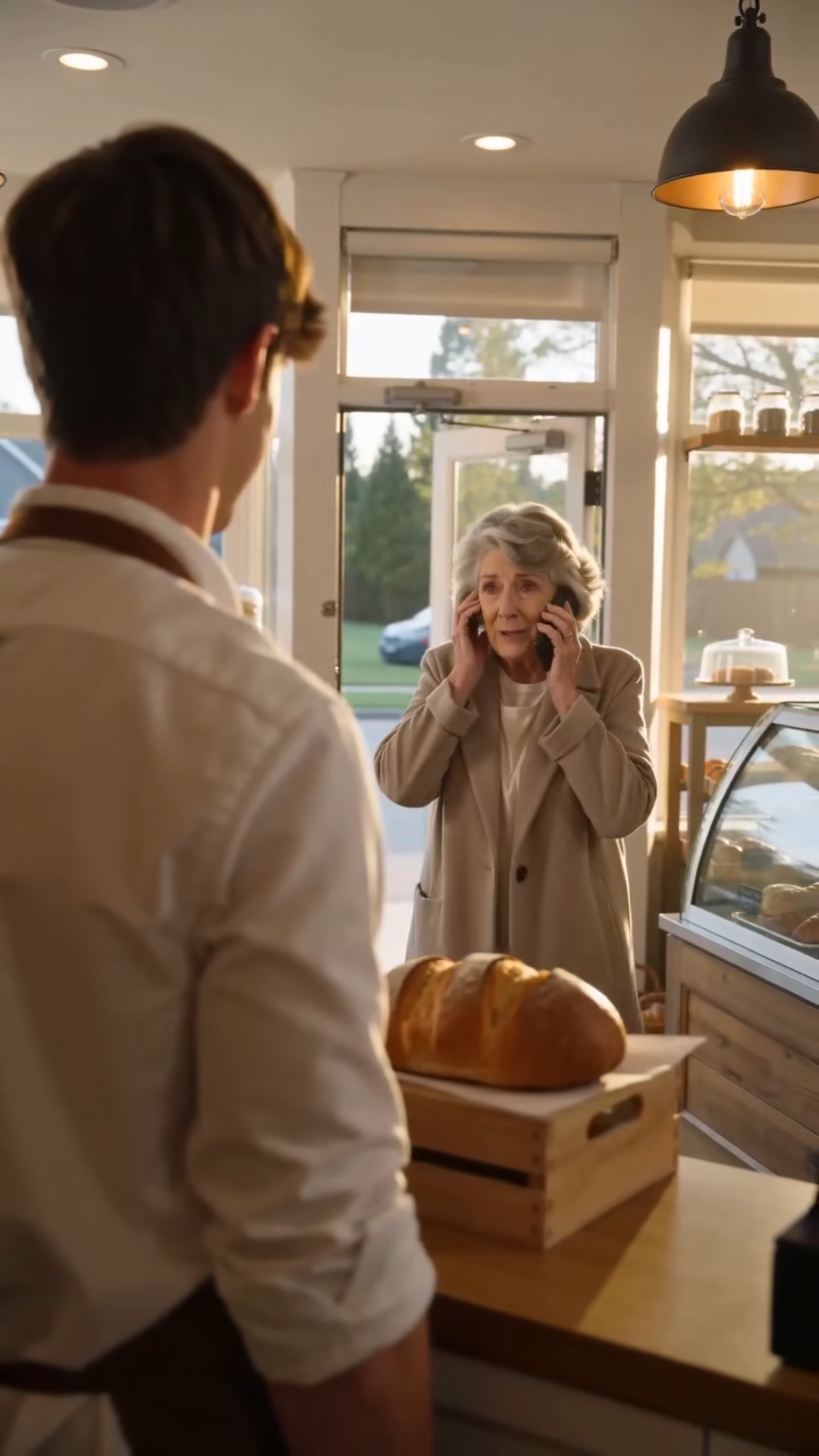
Near the end of the line stood an elderly woman.
Her name was Eleanor Brooks, though no one inside the bakery knew it yet.
She looked to be in her late seventies.
Her silver hair was damp from the rain. A dusty blue knitted cardigan hung loosely over a cream blouse. She wore a dark plum skirt and brown leather shoes that had clearly traveled many miles.
In her hand was an old leather wallet.
Eleanor had entered quietly ten minutes earlier.
She did not look at the pastries.
She did not ask about prices.
She walked directly toward the bread shelves and studied them with careful attention.
Finally, she chose one simple loaf.
Not the cheapest.
Not the most expensive.
A round country loaf with a dark crust and a small flour mark shaped almost like a handprint.
She carried it to the counter with both hands.
Liam noticed the way she held it.
Not like a purchase.
Like something important.
When her turn arrived, she placed the loaf in front of him.
“Good evening,” Liam said.
Eleanor looked up.
Her face was tired, but her eyes were gentle.
“Good evening, young man.”
Liam scanned the bread.
The register displayed the price.
Seven dollars and forty cents.
Eleanor froze.
Her hand rested on the edge of the counter.
For several seconds, she said nothing.
Then she slowly opened her old wallet.
Inside were three folded dollar bills, several coins, a bus ticket, and a faded photograph.
Liam looked away to give her privacy.
Eleanor counted.
Three dollars.
One quarter.
Two dimes.
Four pennies.
Three dollars and forty-nine cents.
She counted again.
Behind her, a man shifted impatiently.
A woman holding a coffee looked toward the door.
Walter noticed the delay.
Eleanor closed her wallet.
Then she placed both hands on the loaf.
“I don’t have enough.”
Her voice was barely louder than the rain.
She slowly pushed the bread back toward Liam.
“I’m sorry.”
Liam looked at the price.
Then at the woman.
“Would you like a smaller loaf?”
Eleanor shook her head.
“No, thank you.”
“There are rolls for seventy-five cents.”
“I know.”
“Would those help?”
She looked down.
“No.”
There was something in her answer that stopped him from asking further.
She did not simply want food.
She wanted this loaf.
Liam glanced toward Walter.
The manager was speaking to a customer near the espresso machine.
Liam reached beneath his burgundy apron and removed his wallet.
Inside were eleven dollars.
Five dollars for the bus pass he needed the next morning.
Four dollars for his sister’s school lunch account.
Two dollars he had planned to spend on cold medicine for his mother.
He took out four dollars.
“I’ll cover the rest.”
Eleanor looked at him in surprise.
“No.”
“It’s okay.”
“You need that money.”
“So do you.”
“You don’t know me.”
Liam gave a small smile.
“That doesn’t change the price.”
Eleanor looked at the bills in his hand.
Her eyes filled with an emotion he could not understand.
“Why would you do this?”
Liam placed the money beside the register.
“Because you shouldn’t have to walk back into the rain without dinner.”
The man behind Eleanor stopped shifting.
The woman with the coffee lowered her cup.
Liam completed the transaction.
He placed the loaf inside a brown paper bag and handed it across the counter.
Eleanor accepted it slowly.
“Thank you, son.”
Walter’s voice cut through the quiet.
“What are you doing?”
He walked toward the counter.
His polished shoes struck the tile with sharp, controlled steps.
Liam remained still.
“I paid the difference.”
Walter looked at the open wallet.
“With your own money?”
“Yes.”
“You can’t do that.”
Liam frowned.
“I didn’t discount the product.”
“That isn’t the point.”
“The register is balanced.”
“You are working. You are not running a charity.”
Eleanor stepped back.
“This was my fault.”
Walter barely looked at her.
“No, ma’am. This employee has repeatedly ignored instructions.”
Liam’s expression changed.
“That’s not true.”
“You gave free coffee to a delivery driver last week.”
“He had been outside for six hours.”
“You allowed a homeless man to sit near the heater after closing.”
“It was twenty degrees.”
“And now you are interfering with a transaction.”
“I paid.”
Walter pointed directly at him.
“You can’t do that.”
Liam looked toward Eleanor.
She held the bread tightly against her cream blouse.
“She deserves to eat.”
The bakery became silent.
The espresso machine stopped hissing.
Even the customers near the entrance turned around.
Walter’s face hardened.
“You don’t decide what people deserve.”
Liam answered calmly.
“Maybe that’s the problem.”
A quiet gasp moved through the line.
Walter stepped closer.
“What did you say?”
Liam knew he should apologize.
He knew his family needed his paycheck.
He knew Walter had already reduced another employee’s hours for speaking back.
But he also knew the woman was watching him.
And something in her expression reminded him of his grandmother, who had died the winter before his father.
Liam lowered his voice.
“I said maybe the problem is that nobody thinks it’s their place to care.”
Walter stared at him.
Then he reached toward Liam’s apron.
“Give me your badge.”
Liam looked down at the small black name tag pinned above his chest.
“Are you firing me?”
“I’m suspending you pending review.”
“For buying bread?”
“For insubordination.”
Liam slowly removed the badge.
His fingers trembled, but his voice did not.
He placed it on the counter.
Walter took it.
“You can collect your final schedule tomorrow.”
Liam nodded once.
Then Eleanor moved.
She held the loaf in one arm and reached into the pocket of her dusty blue cardigan.
She removed an old flip phone.
The plastic was scratched. The silver hinge had dulled with age.
Walter glanced at it with impatience.
“Ma’am, the store is closing soon.”
Eleanor ignored him.
She opened the phone.
The sharp snap echoed through the bakery.
She pressed one number and raised it to her ear.
No one spoke.
“Thank you, son,” she said again, looking at Liam.
Then someone answered.
Eleanor’s posture changed.
Her shoulders straightened.
Her voice became controlled and authoritative.
“Yes. I found the young man.”
She paused.
“Please come to Carter’s Bakery.”
Another pause.
“No. Do not call first.”
She looked at Walter.
“I want them to see everything exactly as it is.”
She ended the call but kept the phone in her hand.
Walter gave a short, nervous laugh.
“Who exactly is coming?”
Eleanor looked toward the faded Carter’s Bakery sign above the shelves.
“People who have been searching for this place for a very long time.”
Liam felt confused.
“Searching for the bakery?”
Eleanor looked at him.
“No.”
Her eyes moved to the flour burn on his hand.
“They were searching for you.”
Ten minutes later, three black vehicles stopped outside.
The bakery door opened.
A woman in a charcoal coat entered with two attorneys, a financial officer, and a man carrying a document case.
Walter’s face lost all color.
He recognized the woman.
Her name was Caroline Brooks.
She was the chief legal officer of Brooks Family Holdings, one of the largest privately owned food distribution and retail companies in the Midwest.
Caroline approached Eleanor.
“Mrs. Brooks, are you all right?”
Liam stared at the elderly woman.
Eleanor Brooks.
The name appeared on grocery stores, warehouses, foundations, and scholarship programs across several states.
But the photographs Liam had seen showed a wealthy businesswoman wearing tailored suits, not an exhausted woman in a rain-soaked cardigan.
Eleanor nodded.
“I’m fine.”
Caroline looked at the bread.
“Did you complete the visit?”
“Yes.”
Walter stepped forward.
“Mrs. Brooks, I can explain.”
Eleanor’s eyes remained on Liam.
“I’m not sure you can.”
She turned toward Caroline.
“Begin the emergency review.”
Walter swallowed.
“Review of what?”
Caroline opened the document case.
“Carter’s Bakery, its parent company, and every property acquired from the Carter estate during the last three years.”
Liam stopped breathing.
Eleanor looked at him.
“Your father once saved more than this bakery.”
She placed the old flip phone on the counter.
“And tonight, you proved he did not leave his courage behind.”
PART 2 — THE DEBT HIDDEN BEHIND THE BAKERY NAME
The bakery closed early.
Customers were asked to leave their contact information if they had recorded the incident. Several offered the videos voluntarily.
Walter remained near the counter with his arms crossed.
His confidence had not completely disappeared, but it had become defensive.
Liam stood beside the bread shelves.
He no longer had his badge.
He no longer knew whether he had a job.
And now one of the most powerful businesswomen in the state was speaking as though she had known his father.
Caroline Brooks placed several folders on a table.
Eleanor sat near the window.
The rain continued to move across the glass behind her.
Liam remained standing.
“You knew my dad?”
Eleanor nodded.
“Daniel Carter worked for Brooks Food Distribution sixteen years ago.”
“My father was a baker.”
“He became one.”
Before opening Carter’s Bakery, Daniel had worked as a warehouse maintenance technician. The company was smaller then, operating only three distribution centers.
One night, a refrigeration unit failed.
The warning system had been disconnected during repairs.
Thousands of pounds of food were at risk, but that was not the greatest danger.
A gas leak had begun near the backup generators.
Daniel smelled it before the sensors reacted.
He evacuated forty-seven employees.
Then he returned to help an injured mechanic who had collapsed near the loading bay.
The building caught fire less than three minutes later.
Daniel survived with burns to his shoulder and arms.
The mechanic survived too.
Eleanor’s husband, Thomas Brooks, had been inside the warehouse that night.
“He was the man your father carried out,” she said.
Liam looked at the scar on his own hand.
“My dad never told me.”
“He refused publicity.”
“That sounds like him.”
Eleanor smiled sadly.
“Thomas offered him money, a management position, and part ownership in a new bakery division. Daniel refused all of it.”
“Why?”
“He wanted to open a neighborhood bakery with his own name.”
Caroline opened the first folder.
Thomas Brooks quietly invested in Carter’s Bakery through a legal trust. The investment was designed so that Daniel would retain control while repaying it slowly.
But after Thomas died, several company officers reviewed old private agreements.
The bakery loan was sold to an outside investment firm.
That firm was controlled by Raymond Collins.
“Raymond bought the bakery,” Liam said.
“Yes.”
“He said my dad had defaulted.”
“He did miss payments during your mother’s medical leave. But the original agreement gave him eighteen months to recover.”
Liam’s face tightened.
“He never got eighteen months.”
“No.”
Raymond had used a modified copy of the agreement.
He claimed immediate default rights.
Daniel lost control of the bakery but continued working there under a management contract because he could not bear to leave the business.
Six months later, he died.
Liam sat down.
For two years, he had believed his father had simply failed.
Walter spoke.
“This has nothing to do with me.”
Caroline turned toward him.
“You became manager three months after the acquisition.”
“I was hired by Mr. Collins.”
“And you enforced wage deductions not permitted under state law.”
Walter’s face changed.
“I followed company policy.”
“You charged employees for unsold food.”
“That reduced waste.”
“You altered time records.”
“I corrected inaccurate clock-ins.”
“You withheld tips from the coffee counter.”
“They were pooled for operations.”
Liam looked at Walter.
“You said the tips paid for cleaning supplies.”
Walter ignored him.
Caroline continued.
“You also reported charitable bread donations that were never delivered.”
Eleanor looked toward the shelves.
“What happened to the bread?”
Walter hesitated.
“Some products were sold to a discount reseller.”
“While recorded as donations?”
“I did what Mr. Collins instructed.”
Eleanor’s voice became colder.
“So when a woman could not afford one loaf, you defended the rules. But when your owner sold donated food for private profit, you found flexibility.”
Walter looked toward the attorneys.
“I want representation.”
“You should have it,” Caroline replied.
He was suspended immediately.
The employees would be interviewed.
Payroll records would be preserved.
The bakery’s accounts would be frozen pending investigation.
But Liam still wanted to understand one thing.
“Why did you come dressed like this?”
Eleanor looked at her cardigan.
“To see how the bakery treated someone who appeared to have no influence.”
“You tested us.”
“Yes.”
Liam felt anger rise.
“You had enough money.”
“Yes.”
“You watched me lose my job.”
“I did not expect Walter to suspend you so quickly.”
“But you let him.”
Eleanor did not defend herself.
“Yes.”
Liam stood.
“You knew my family needed this job?”
“I knew your name. I did not know your circumstances.”
“That didn’t matter when you decided to use me.”
Caroline looked toward Eleanor.
The older woman remained quiet.
Liam continued.
“You wanted to know whether I was like my father.”
“Yes.”
“So you created a situation where I had to choose between my paycheck and helping you.”
Eleanor lowered her eyes.
“I was wrong.”
The admission surprised him.
“I thought the truth would justify the method,” she said. “It does not.”
Liam looked at the bread in her hands.
“Would you have helped me if I had refused?”
“Yes.”
“Then the test didn’t prove whether I deserved help. It only proved how much you were willing to risk on my behalf without asking me.”
Eleanor accepted the words.
“You are right.”
Walter gave a bitter laugh from across the room.
“Now that the dramatic reunion is over, maybe everyone can admit the boy broke policy.”
Eleanor looked at him.
“No.”
She stood slowly.
“The dramatic reunion has not begun.”
She asked Caroline for the second folder.
Inside was a handwritten letter.
The envelope carried Daniel Carter’s name.
Liam recognized his father’s handwriting immediately.
“When was this written?”
“Three days before his death,” Eleanor said.
The letter was addressed to Thomas Brooks, though Thomas had already been dead for nearly a year.
Daniel apparently did not know whom else to trust.
He wrote that Raymond Collins had pressured him to sign away permanent rights to the bakery.
He believed Collins had obtained private information from Brooks Holdings.
He also wrote about Liam.
My son wants to study baking, but I have tried to discourage him. I do not want him trapped beneath my debts. If he chooses this life anyway, please do not hand him anything because of me. Watch how he treats people when no reward is visible. Then decide whether he should carry the Carter name.
Liam stopped reading.
His throat tightened.
His father had known he might lose everything.
And still, he worried about whether Liam would deserve the bakery.
Eleanor said gently, “That is why I came.”
Liam folded the letter.
“You should have shown me this first.”
“Yes.”
“Instead of pretending to be hungry.”
“Yes.”
Liam looked at her.
“Why didn’t you?”
Eleanor’s composure finally broke.
“Because I was afraid.”
“Of what?”
“That if I came as Eleanor Brooks, everyone would behave well.”
“That isn’t what I asked.”
She looked toward the dark window.
“I was afraid you would be kind only because you wanted the bakery back.”
Liam felt hurt.
“You thought that little of me?”
“I did not know you.”
“Then you should have met me.”
Silence filled the room.
Caroline closed the folders.
“We can stop for tonight.”
Liam picked up his coat.
“What happens to my job?”
“You are reinstated,” Caroline said.
“I don’t want the job under Walter.”
“He will not return during the investigation.”
“And Raymond?”
Caroline’s expression hardened.
“He has been notified of the audit.”
Liam moved toward the door.
Eleanor called after him.
“Liam.”
He stopped.
“I am sorry.”
He looked back.
“For pretending to be poor?”
“For believing power gave me the right to test your character.”
Liam did not answer.
He stepped into the rain.
The next morning, the bakery’s financial system was found partially erased.
Raymond Collins had attempted to delete payroll records, property transfers, and supplier contracts.
A backup server preserved most files.
But one folder was missing.
The folder contained the original trust agreement proving the Carter family still had legal ownership rights.
Without it, Raymond could argue that the agreement had been lawfully terminated.
Then police arrived at Liam’s apartment.
Five thousand dollars had been discovered inside his locker at the bakery.
Raymond claimed Liam had been stealing cash for months.
The young man who had paid four dollars for a stranger’s bread was suddenly accused of robbing the business his father had lost.
PART 3 — THE BOY THEY CALLED A THIEF
By noon, Liam’s name had spread across the neighborhood.
A customer had uploaded the bakery video the previous night.
At first, people praised him.
Local pages shared the moment he said, “She deserves to eat.”
Then Raymond Collins released a statement.
The employee shown in the viral recording is currently under investigation for significant financial misconduct. The public is urged not to confuse staged generosity with integrity.
The comments changed quickly.
Some people said Liam had paid for the bread to create sympathy.
Others claimed Eleanor Brooks had been tricked.
A few posted photographs of the Carter family’s apartment building and asked how an eighteen-year-old bakery worker could afford new headphones he had received as a birthday gift.
At school, students whispered.
One boy held up four dollars and asked whether Liam wanted to “cover the rest.”
Liam walked away.
He had learned that anger gave cruel people the evidence they hoped to find.
His mother did not doubt him.
Rebecca Carter sat at the kitchen table reading the police document.
“You never had access to five thousand dollars.”
“No.”
“Who knew your locker combination?”
“Walter. Maybe Raymond.”
“Anyone else?”
“Some employees knew the first two numbers.”
Grace stood near the doorway.
“Are they going to arrest him?”
Rebecca looked at her daughter.
“No.”
But Liam heard the uncertainty.
Caroline Brooks arranged legal representation.
Liam almost refused.
“I don’t want another favor.”
“It is not a favor,” Caroline said. “The accusation is connected to our investigation.”
Eleanor did not attend the first meeting.
She understood that her presence might feel like pressure.
The bakery’s security system became central to the case.
The camera facing the lockers had failed two hours before the money was “discovered.”
Walter claimed the failure was ordinary.
The technician disagreed.
Someone had disconnected the network cable manually.
A hallway camera showed Raymond entering the employee area late the previous evening.
He carried no visible bag.
When he left, his coat appeared slightly fuller.
But the image was not clear enough.
Raymond’s attorney argued he had entered to collect corporate documents.
The cash itself carried mixed fingerprints.
Liam’s prints appeared on several bills.
He stared at the report.
“I never touched them.”
Caroline asked whether he had handled cash bundles recently.
Liam remembered.
Three weeks earlier, Walter had asked him to count the weekend deposit after another employee called in sick.
The bills could have come from that deposit.
Someone had preserved money he touched, then planted it.
The plan had not begun after Eleanor’s visit.
Raymond had prepared a scapegoat earlier.
“Why me?” Liam asked.
Caroline opened another financial file.
Because Daniel Carter had never fully transferred his ownership.
Under the trust agreement, if Daniel died before repaying the investment, his voting rights passed to his oldest child at age eighteen.
Liam had turned eighteen three months earlier.
If the original agreement existed, he could challenge Raymond’s ownership.
Raymond needed him discredited before he discovered that.
Eleanor finally came to the apartment that evening.
She stood outside in the rain wearing the same dusty blue cardigan.
Rebecca opened the door but did not invite her inside immediately.
“You used my son.”
Eleanor nodded.
“Yes.”
“And now powerful men are trying to destroy him.”
“Yes.”
“Can you stop them?”
“I can help expose them.”
“That is not what I asked.”
Eleanor looked at her.
“No. I cannot promise to stop every consequence.”
Rebecca studied her for a long moment.
Then she stepped aside.
Eleanor entered.
She did not bring attorneys.
She did not bring money.
She carried only the loaf of bread.
The original loaf Liam had purchased.
It was now dry.
She placed it on the table.
“I could not eat it.”
Liam looked at her.
“Why?”
“Because it became evidence of my mistake.”
Grace frowned.
“It’s just bread.”
Eleanor smiled sadly.
“No, sweetheart. It is what your brother risked before he knew anyone important was watching.”
Liam sat across from her.
“Did you find the trust agreement?”
“No.”
“Then Raymond wins.”
“Not necessarily.”
Eleanor had spent the day reviewing Thomas Brooks’s personal archives. Her husband kept duplicate records in unexpected places.
Old storage boxes.
Books.
Photographs.
Private recordings.
Daniel had once delivered a wooden bread box to Thomas as a thank-you gift.
The box remained in Eleanor’s home.
Inside its false bottom, she found a key.
The key opened a private deposit box registered jointly to Thomas Brooks and Daniel Carter.
The bank would open it the next morning.
Liam looked at her.
“You think the agreement is there?”
“I do not know.”
“Then why tell us?”
“Because you deserve information, not another surprise arranged around you.”
That answer mattered.
The next morning, Liam, Rebecca, Eleanor, Caroline, and a bank officer entered the vault.
Inside the deposit box were three envelopes.
The first contained the original trust agreement.
The second contained property deeds.
The third contained an audio recorder.
Daniel’s voice filled the private room.
If this is being heard, Raymond Collins has likely challenged the bakery trust. Thomas believed Raymond was diverting company money through supplier contracts. I agreed to help document it. If something happens to me, protect my family, but do not hide the truth from Liam. He must choose what to do with the bakery. Do not choose for him.
Eleanor closed her eyes.
She had violated Daniel’s final request by arranging the test.
Liam kept listening.
The recording described false invoices, hidden ownership companies, and cash taken from employee wages.
It also identified a storage facility where Daniel had kept copies.
Federal investigators searched the location.
They found records proving Raymond had stolen from six small businesses acquired through similar methods.
He targeted owners facing illness, death, or temporary debt.
Then he rewrote agreements and forced them out.
Walter had helped falsify payroll records and plant money in Liam’s locker.
Under questioning, Walter agreed to cooperate.
He admitted Raymond ordered him to create the theft accusation weeks earlier.
Raymond was arrested for fraud, evidence tampering, wage theft, and conspiracy.
Liam was publicly cleared.
The same pages that called him a thief now posted apologies.
Most did not remove their original accusations.
Liam learned how slowly truth repaired what suspicion damaged quickly.
But another problem remained.
The trust agreement restored the Carter family’s controlling rights.
It also restored nearly four hundred thousand dollars in debt.
The bakery building needed repairs.
Employees were owed back wages.
Suppliers demanded payment.
Legally, Liam could reclaim Carter’s Bakery.
Financially, doing so might destroy his family.
Eleanor offered to repay every debt.
Liam refused.
“You would own it again.”
“I could structure the money as a grant.”
“Then everyone would say I received the bakery because I bought you bread.”
“Does that matter?”
“Yes.”
“Why?”
“Because I need to know whether I can build something, not just inherit a rescue.”
Eleanor nodded.
“What do you propose?”
Liam had spent several nights speaking with employees.
The bakers.
The baristas.
The delivery driver.
The part-time students whose wages had been stolen.
He proposed converting Carter’s Bakery into an employee-owned community business.
The Carter family would retain a minority legacy share.
Employees would receive ownership through unpaid wage settlements.
Brooks Holdings could invest, but without controlling votes.
A neighborhood trust would protect the building from future sale.
Eleanor studied the plan.
“You would give away control your father wanted you to receive.”
Liam shook his head.
“My father wanted me to choose.”
“And this is your choice?”
“He lost the bakery because too much depended on one family having enough money. I don’t want the next crisis to destroy everyone again.”
Eleanor smiled.
“Thomas would have invested.”
“Under the same rules as everyone else?”
She laughed.
“He would have argued first.”
“Then?”
“Then he would have agreed.”
The plan went before a bankruptcy judge.
Raymond’s remaining creditors opposed it.
A property developer offered three times the bakery’s appraised value and planned to replace it with luxury apartments.
The final hearing would determine whether the bakery survived.
Before the judge ruled, Walter Briggs requested permission to speak.
He stood in the courtroom without his polished confidence.
“I helped Raymond target Liam.”
Liam looked at him.
Walter continued.
“I told myself I was protecting my job. I called cruelty discipline and theft efficiency.”
He admitted planting the money.
He admitted humiliating employees.
He gave up his claim to severance and transferred his retirement interest in the company toward unpaid wages.
It did not erase his choices.
But it helped prove the bakery had been intentionally mismanaged.
The judge approved Liam’s plan.
Carter’s Bakery would survive.
But only if the new cooperative could raise enough money for repairs within sixty days.
They had ownership.
Now they had to earn a future.
PART 4 — THE BAKERY THAT BELONGED TO EVERYONE
The first fundraising day began before sunrise.
Liam arrived wearing the same muted forest-green polo, deep burgundy apron, charcoal trousers, and worn beige sneakers.
The bakery still carried scars from years of neglect.
One oven heated unevenly.
The roof leaked near the storage room.
Two shelves leaned slightly to the left.
But the doors opened at six.
People were already waiting outside.
Some had seen the video.
Others remembered Daniel Carter.
Former employees returned.
Neighbors donated.
A carpenter repaired the shelves without charging labor.
An electrician replaced dangerous wiring at cost.
A retired baker volunteered to train the younger staff.
Eleanor arrived quietly.
No black vehicles.
No legal team.
She wore her dusty blue cardigan and carried the preserved loaf inside a wooden box.
Liam looked at it.
“You kept it.”
“Yes.”
“It must be stone by now.”
“Probably.”
“What are you going to do with it?”
“Ask permission.”
“For what?”
“To place it in the bakery.”
Liam considered.
“Only if the story explains the test was wrong.”
Eleanor smiled.
“Especially that part.”
A small display was created near the counter.
Inside rested the dry loaf, Eleanor’s old flip phone, Liam’s original badge, and a copy of Daniel’s letter.
The plaque did not call Eleanor a hero.
It did not call Liam a saint.
It read:
A GOOD DEED SHOULD NEVER REQUIRE A PERSON TO RISK THEIR LIVELIHOOD. THIS BAKERY EXISTS TO MAKE KINDNESS PART OF THE SYSTEM, NOT AN EXCEPTION TO IT.
The cooperative introduced several changes.
Employees received paid breaks.
Tips went directly to staff.
Unsold bread was recorded and delivered to verified shelters.
A quiet community shelf allowed customers to take prepaid bread without explaining their situation publicly.
Anyone could purchase an extra loaf for someone else.
The program was called The Covered Rest.
Liam disliked the name at first.
Grace had suggested it.
“You said, ‘I’ll cover the rest,’” she explained.
He accepted.
The bakery also began offering apprenticeships to local teenagers.
Not unpaid internships.
Paid training.
Liam enrolled in a culinary program while working part-time.
He refused the title of owner.
His official role was apprentice representative on the cooperative board.
Eleanor attended meetings as a nonvoting adviser.
At the first meeting, she proposed a large marketing campaign built around the viral video.
Liam rejected it.
“We’re not turning hunger into advertising.”
Eleanor nodded.
“Agreed.”
“You agreed too quickly.”
“I am learning.”
The bakery raised enough money in fifty-three days.
Brooks Holdings invested the final amount under the cooperative rules.
No controlling shares.
No special veto.
Eleanor signed the agreement without negotiation.
Rebecca became the bakery’s community coordinator.
She organized partnerships with schools, shelters, and senior centers.
Grace helped design paper bags decorated with drawings from neighborhood children.
One year after reopening, Carter’s Bakery became profitable.
Not enormously profitable.
But stable.
Employees received their first annual profit-sharing checks.
Some cried.
One barista used hers to repair her car.
A baker paid an overdue medical bill.
Liam placed his check toward his culinary tuition.
Walter served eighteen months in a work-release program after cooperating with investigators.
When he was released, he came to the bakery.
Liam found him outside before opening.
Walter looked older.
His shirt was wrinkled.
His shoes were no longer polished.
“I’m not asking for my job back,” he said.
“Good.”
“I came to apologize.”
“You already testified.”
“That was about the crime.”
He looked through the window.
“This is about what I did every day before the crime.”
Liam remained silent.
Walter continued.
“I believed poor employees should be grateful for any job. I believed customers without money were problems. I believed rules mattered more when they protected people like me.”
Liam asked, “Why are you telling me?”
“Because I spent years thinking an apology only counted if it earned forgiveness.”
“And now?”
“Now I think it counts if it tells the truth.”
Liam did not forgive him that morning.
But he allowed Walter to join a supervised volunteer program repairing equipment for community kitchens.
Trust returned slowly.
Not as a reward.
As a process.
Eleanor’s health began declining two years later.
She visited less often.
One rainy evening, she entered the bakery using a cane.
Liam was twenty-one by then.
He had completed his first professional certification and developed a new country loaf using Daniel’s original recipe.
He placed one on the counter.
“No charge,” he said.
Eleanor raised an eyebrow.
“Against policy?”
“You’re a board adviser. Consider it a meeting expense.”
She laughed.
Then she opened her old wallet.
Inside were four dollars.
The same amount Liam had once paid.
She placed them on the counter.
“What is this?”
“The rest.”
“You repaid me years ago.”
“No. Brooks Holdings invested. I never did.”
Liam took the bills.
Then dropped them into the community bread box.
“Now you have.”
Eleanor looked toward the display containing the old loaf.
“I still regret that evening.”
“You should.”
She smiled.
“You remain direct.”
“You taught me powerful people need direct answers.”
“No. Your father did.”
They sat near the rain-covered window.
Eleanor asked, “Do you hate me for the test?”
Liam thought carefully.
“No.”
“Did you forgive me?”
“Mostly.”
“What remains?”
“The part of me that wonders whether you would have helped if I had failed.”
Eleanor looked down.
“I would have restored the bakery.”
“But would you have respected me?”
She did not answer immediately.
“I do not know.”
Liam appreciated the honesty.
Eleanor continued.
“That is the part I regret most. I believed one moment could measure an entire person.”
Liam nodded.
“People make bad choices when they’re scared.”
“Yes.”
“They also make good choices for selfish reasons.”
“Yes.”
“So maybe we shouldn’t build systems that depend on guessing who deserves help.”
Eleanor looked around the bakery.
“That is what you built.”
“No. We built it.”
She corrected him.
“They built it.”
She pointed toward the employees closing the pastry case.
The customers at the tables.
Rebecca speaking with a shelter volunteer.
Grace doing homework near the coffee machine.
Liam smiled.
“Yes.”
Eleanor died peacefully the following spring.
In her will, she did not leave Liam personal wealth.
She knew he would refuse it.
Instead, she created a national fund supporting employee-owned neighborhood bakeries and food businesses.
The fund operated under one unusual condition:
Every grant committee had to include hourly workers from the businesses applying for help.
The program was named the Thomas and Daniel Community Food Trust.
Ten years after the rainy evening, Carter’s Bakery still stood on the same corner.
The faded sign had been restored.
The wooden shelves were straight.
The old counter remained.
Liam was twenty-eight.
He had become the head baker, though the title embarrassed him.
He still wore a forest-green polo on busy days.
His burgundy apron was newer.
His beige sneakers had finally been replaced, but the old pair sat in the display beside the loaf.
The cooperative employed thirty-two people.
Several former apprentices had opened businesses of their own.
The Covered Rest program had provided more than eighty thousand loaves to families, seniors, students, and anyone else who needed food.
No forms.
No public explanations.
A customer could simply point to a small wooden token near the register.
One rainy evening, an elderly woman entered.
She wore a gray coat and carried a nearly empty purse.
She selected a loaf.
At the register, she discovered she was short by two dollars.
The young cashier looked toward Liam.
The woman started pushing the bread back.
“I don’t have enough.”
The cashier smiled.
“It’s already covered.”
The woman looked confused.
“By whom?”
The cashier pointed toward the wooden board.
Dozens of small tokens hung there.
“Someone who came before you.”
The woman’s eyes filled.
“I don’t want charity.”
Liam approached.
“It isn’t charity.”
“What is it?”
He thought of Eleanor.
His father.
The old phone.
The planted money.
The courtroom.
The employees who had rebuilt the bakery.
“It’s proof that this neighborhood expects you to come back tomorrow.”
The woman accepted the bread.
No one filmed.
No manager shouted.
No powerful stranger revealed a hidden identity.
The moment remained ordinary.
That was the victory.
After closing, Liam stood alone near the display.
He looked at the preserved loaf.
Eleanor’s dusty blue cardigan had been added after her death, folded beneath the old phone.
Daniel’s letter remained behind the glass.
Liam touched the frame.
Grace, now studying business management, approached with two cups of coffee.
“Talking to the bread again?”
“It listens better than the board.”
She handed him a cup.
“Mom says the roof is leaking near storage.”
“Again?”
“Historic buildings have character.”
“Historic buildings have repair bills.”
They laughed.
Outside, rain moved across the windows.
The bakery lights reflected on the wet street.
A family entered just before the doors were locked.
They had been delayed at the hospital.
The children looked hungry.
Liam turned the sign back to OPEN.
Grace raised an eyebrow.
“We’re closed.”
“They’re here.”
“That is not the same thing.”
“It is tonight.”
She smiled and returned to the counter.
Liam warmed soup.
One employee sliced bread.
Another restarted the coffee machine.
The family sat near the window.
No one asked how much money they carried.
Years earlier, Liam had believed his four dollars changed Eleanor’s life.
He later understood the truth.
Her arrival changed his.
But not because she was wealthy.
Not because she restored the bakery.
Not even because she revealed what had happened to his father.
She forced him to decide what kind of business should exist after the truth was known.
He could have reclaimed Carter’s Bakery as a family possession.
Instead, he made it a shared promise.
His father had wanted him to carry the Carter name only if he respected people more than prestige.
Liam finally understood that carrying the name did not mean placing it above the door.
It meant making sure the door remained open.
The family finished eating.
The youngest child approached the display.
“Why is there an old loaf in there?”
Liam crouched beside him.
“Because someone couldn’t afford it.”
“Did they get to eat?”
“Yes.”
“Then why didn’t they eat that one?”
Liam smiled.
“Because it became something else.”
“What?”
“A reminder.”
The child looked at the dry bread.
“Of what?”
Liam glanced toward the counter where prepaid tokens waited quietly for tomorrow.
“That nobody should have to prove they’re important before someone helps them.”
The child considered the answer.
Then nodded as if it were obvious.
Perhaps to a child, it was.
The family left beneath one umbrella.
Liam locked the door.
The bakery became quiet.
He turned off the front lights but left one lamp glowing above the wooden board.
Dozens of covered loaves remained available.
For students.
For tired parents.
For elderly customers.
For strangers.
For anyone who might enter with an old wallet and not quite enough money.
Rain continued to fall over Carter’s Bakery.
Inside, warm bread cooled on the shelves.
And the kindness that once cost Liam his job had become the rule no manager could ever take away.