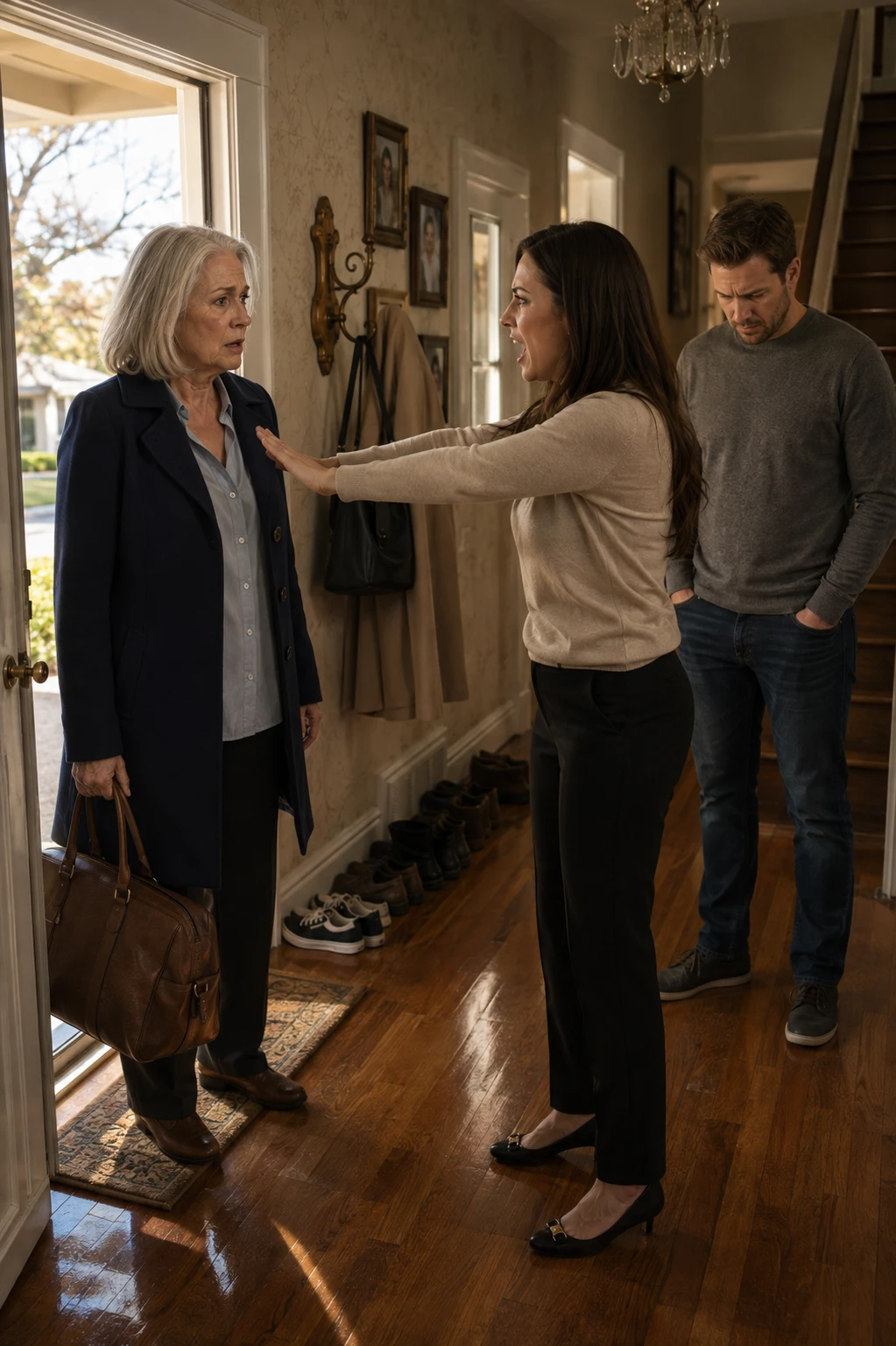
Jessica crossed her arms.
“What document?”
I looked at her for a long moment.
Then I turned toward Matthew.
His expression had already changed.
He knew.
Or at least he suspected.
“Mom,” he said carefully, “let’s not make this bigger than it needs to be.”
I almost laughed.
Not because anything was funny.
Because those words had followed me through most of my life.
Don’t make it bigger.
Don’t cause trouble.
Don’t embarrass anyone.
Don’t react too strongly when people take something from you.
Be patient.
Be understanding.
Be the mother.
Be the widow.
Be the one who sacrifices.
But something inside me had shifted the moment Jessica told me to get out of my own house.
For years, I had mistaken silence for peace.
Now I understood that silence had simply made me easier to use.
“I didn’t make this situation,” I said. “You did.”
Matthew stepped into the bedroom.
“We only moved in because we had nowhere else to go.”
“You have an apartment.”
Jessica rolled her eyes.
“That place is tiny.”
“It was large enough when I helped you pay the deposit.”
Her expression tightened.
Matthew glanced at her.
Apparently that detail had not been part of the version of their life she liked telling people.
He lowered his voice.
“Our lease is ending.”
“Next month.”
“We had to plan ahead.”
“Planning ahead would have involved asking me.”
Jessica stood and set the nail polish bottle on my dresser.
“We knew you’d say no.”
I looked at her.
“Then you knew you had no right to do it.”
She opened her mouth.
No words came.
That was the first time I saw uncertainty enter her face.
Only a flicker.
But it was there.
I reached toward the photograph of George.
Her cosmetics had been placed in front of it.
I lifted the frame carefully and wiped a small streak of pink polish from the corner.
George looked back at me with the same quiet expression he had worn on our twenty-fifth wedding anniversary.
The photograph had been taken on the front porch.
He had spent the entire afternoon repairing a loose step, then complained that I had chosen the one day his shirt was covered in sawdust to take pictures.
I had told him he looked handsome.
He told me I needed glasses.
That was George.
He never needed expensive things.
He only wanted a house where the people he loved felt safe.
Now his son stood in that house helping someone erase me from it.
I set the picture back where it belonged.
“You have forty-eight hours,” I repeated.
Jessica laughed again, but this time the sound was forced.
“You can’t throw us out.”
“I am not throwing you out.”
I faced her.
“You entered without permission.”
“I am telling you to leave.”
“This is Matthew’s home too.”
“No.”
My son finally looked at me.
“Mom.”
“It is not your home, Matthew.”
His face hardened.
“I grew up here.”
“You did.”
“Dad wanted me to have it.”
The words struck harder than I expected.
For one moment, I could not breathe.
George had loved our son.
Completely.
But he had also understood him.
Even when Matthew was young, George had worried that I protected him too much.
“He has to learn that love doesn’t mean he gets everything he asks for,” George once told me.
At the time, I had defended our son.
“He’s still finding his way.”
“He’ll be forty and you’ll still be saying that.”
George had been wrong about one thing.
Matthew was thirty-six.
I looked at him now.
“Your father never said that.”
“He would have.”
“You do not get to invent the wishes of a dead man because they are convenient.”
Jessica stepped between us.
“This is ridiculous. We’re married. We’re trying to start a family.”
My eyes moved to her stomach.
She noticed.
“No,” she said quickly. “I’m not pregnant.”
“Then what does starting a family have to do with taking my bedroom?”
“We need stability.”
“So do I.”
“You’re one person.”
There it was.
The idea underneath everything.
One person.
One widow.
One older woman.
As though needing less meant deserving less.
As though the number of people standing behind a demand determined whether it was right.
I took a slow breath.
“You seem very certain that my life matters less than yours.”
“That isn’t what I said.”
“It is exactly what you said.”
Matthew stepped closer.
“Mom, nobody is saying you don’t matter.”
“You moved my belongings into the spare room.”
He froze.
I had not noticed until then.
A small cardboard box sat beside the guest-room door.
I walked toward it.
Inside were my folded sweaters.
My jewelry box.
My slippers.
The old blue robe George gave me.
Someone had packed my bedroom while I was caring for my sick sister.
I picked up the robe.
Underneath it lay a folder of medical brochures.
Assisted-living communities.
Senior apartments.
Memory-care facilities.
The air left my lungs.
I lifted the brochures one by one.
Jessica said nothing.
Matthew looked away.
I turned toward him.
“What is this?”
He rubbed the back of his neck.
“We were looking at options.”
“For whom?”
“Mom…”
“For whom?”
He finally answered.
“You.”
The word fell quietly.
Almost gently.
As if softness could make it less cruel.
I stared at him.
“You planned to move me into assisted living?”
“No,” he said quickly. “We were just considering what might be best.”
“For me?”
“Yes.”
“Without asking me?”
“We didn’t want to upset you.”
I looked at the box of my belongings.
“You packed my room.”
“We thought seeing the space might help you understand.”
“Understand what?”
“That the house is too much for you.”
Jessica found her confidence again.
“You can barely manage the stairs.”
“There are no stairs.”
She paused.
“The yard, then.”
“I pay someone to maintain it.”
“You’re alone here.”
“I like being alone.”
“You say that now.”
I turned toward her.
“You have been living in my house for two weeks and already decided I am incapable of knowing what I want.”
“We’re trying to help.”
“No.”
I held up the brochures.
“You are trying to remove me.”
Matthew stepped forward.
“Mom, that isn’t fair.”
I looked at him.
“Then explain the brochures.”
He said nothing.
“Explain why my clothes were packed.”
Silence.
“Explain why Jessica’s dresses are in my closet.”
Still nothing.
“Explain why you stood behind her while she told me to get out of my own house.”
His face collapsed.
For a heartbeat, I thought he might finally apologize.
Instead, he whispered, “We thought once you saw everything arranged, you’d accept it.”
I nodded slowly.
The honesty hurt more than the lie.
They had counted on my exhaustion.
My age.
My grief.
They had believed that if they moved quickly enough, I would feel too displaced to fight.
I folded the blue robe and returned it to the box.
Then I picked up the assisted-living brochures.
“I’ll take these.”
Jessica gave a small, satisfied smile.
She thought I was considering them.
I walked into the kitchen, opened the trash bin, and dropped them inside.
Her smile vanished.
Then I reached into my handbag and removed my phone.
Matthew watched me.
“Who are you calling?”
“My attorney.”
His eyes widened.
“Mom, don’t.”
I pressed the number.
He reached toward the phone.
I stepped back.
“Do not touch me.”
The words stopped him instantly.
Not because I shouted.
Because I never had before.
My attorney answered on the third ring.
“Margaret?”
“Hello, David.”
“Are you back in town?”
“Yes.”
“Is everything all right?”
“No.”
Both Matthew and Jessica were listening.
I looked directly at them.
“I need you to activate the notice.”
There was a brief pause on the line.
“Are you certain?”
“Yes.”
“What happened?”
“My son and his wife moved into my home without permission and attempted to remove me from it.”
Jessica’s face turned pale.
Matthew whispered, “Activate what notice?”
I ignored him.
David’s voice became professional.
“I’ll have it served today.”
“Good.”
“And the second document?”
“Yes.”
I kept my eyes on Matthew.
“Prepare that too.”
His shoulders stiffened.
“Mom, what second document?”
I ended the call.
Jessica moved toward me.
“You can’t just call a lawyer every time you don’t get your way.”
I slipped the phone back into my bag.
“This is not about getting my way.”
“This is about ownership.”
“We’re family.”
“So you keep saying.”
“You’re really going to involve strangers?”
“My attorney is not a stranger.”
“You know what I mean.”
“Yes.”
I did.
She meant witnesses.
Records.
Consequences.
People who would not be moved by tears, anger, or the word family.
People who would ask whose name was on the deed.
People who would notice that my belongings had been packed.
People who would ask why two adults had attempted to occupy a widow’s home without permission.
Jessica had wanted the matter kept inside the family because families often protect the person causing harm more than the person experiencing it.
I had done that long enough.
Matthew walked toward the living room.
He seemed suddenly exhausted.
“This is getting out of control.”
“No,” I said. “For the first time, it is under control.”
He turned.
“Mom, please.”
I saw fear in his eyes.
Not fear of losing me.
Fear of losing the house.
“What is the notice?” he asked.
I placed my bag on the kitchen chair.
“An occupancy revocation.”
Jessica blinked.
“A what?”
“A formal notice stating that neither of you has permission to reside here.”
Her jaw tightened.
“You let us stay before.”
“For weekends.”
“You gave us keys.”
“For emergencies.”
“That still counts.”
“No.”
Matthew looked confused.
“How long have you had something like that prepared?”
“Eight months.”
The room fell silent.
Jessica recovered first.
“You prepared an eviction notice for us eight months ago?”
“No.”
“I prepared legal instructions regarding unauthorized occupancy.”
“Why?”
“Because eight months ago, your husband asked me to add his name to the deed.”
Matthew looked down.
Jessica turned sharply toward him.
“You told me she was considering it.”
“I was.”
“No, you weren’t.”
“I thought she might.”
I stared at my son.
“After I refused, you asked whether I had made a will.”
His face reddened.
“I was worried.”
“About what?”
“What would happen if something happened to you.”
“You asked how long probate would take.”
Jessica looked between us.
Apparently, this conversation had also been edited when Matthew repeated it to her.
I continued.
“Then, three months ago, you suggested I move closer to Linda.”
“My sister lived three hours away.”
“You said I would be less lonely.”
“She had cancer.”
I could hear my voice changing.
Becoming quieter.
Sharper.
“You knew I might need to stay with her.”
Matthew said nothing.
That was when the full plan became visible.
Not just the move.
The timing.
My sister’s illness.
My absence.
The packed bedroom.
The brochures.
The claim that they had nowhere to go.
The certainty with which Jessica had stood at my door.
This had been planned for months.
Perhaps longer.
“You waited for me to leave,” I said.
Neither answered.
“You knew I would be gone.”
Jessica folded her arms.
“We needed an opportunity to make the transition.”
“The transition.”
“Yes.”
She was no longer pretending.
Perhaps she thought honesty would intimidate me.
Perhaps she had grown tired of hiding her contempt.
“This house should stay in the family,” she continued. “Matthew is your only child.”
“It is in the family.”
“You know what I mean.”
“I do.”
She meant her branch of the family.
Not me.
Not my sister.
Not George’s memory.
Only what she could control.
“You’re sixty-eight,” she said.
I corrected her.
“Sixty-seven.”
“Fine. You’re sixty-seven. You don’t need three bedrooms.”
“And you do?”
“We plan to have children.”
“You told me last year you never wanted children.”
“That can change.”
“So can your address.”
Matthew rubbed his forehead.
“Can everyone please calm down?”
I looked at him.
“Your wife told me to leave my own house.”
“She was upset.”
“She packed my belongings.”
“We both did.”
At least he admitted it.
“You moved George’s jacket.”
He glanced toward the coat rack.
Jessica’s beige coat hung where George’s old brown work jacket had remained for nineteen years.
I had not washed it after he died.
It still held the faintest smell of cedar and engine grease.
Or maybe I only imagined it did.
“Where is it?” I asked.
Neither answered.
“Where is your father’s jacket?”
Matthew’s face changed.
That was enough.
I walked toward the garage.
He moved in front of me.
“Mom.”
“Move.”
“It’s just a jacket.”
The words stopped me.
Just a jacket.
I looked at the man I had raised.
“You carried that jacket for three days after your father died.”
His face tightened.
“You slept with it on the floor beside my bed.”
“I was a kid.”
“You were seventeen.”
“I was grieving.”
“So was I.”
He looked away.
I stepped around him and opened the garage door.
The smell of dust and cardboard hit me.
My rocking chair had been pushed against the wall.
Two lamps.
A side table.
Boxes of books.
Framed photographs.
George’s toolbox.
My entire life had been stacked like unwanted storage.
Then I saw a black trash bag near the workbench.
Something brown protruded from the opening.
I crossed the garage quickly.
My knees nearly gave way when I pulled out George’s jacket.
The sleeve had been torn.
Dark paint marked the front.
I looked at Jessica.
“What happened?”
She shrugged.
“It was filthy.”
“What happened?”
“I used it while repainting the guest room.”
The guest room.
My new room.
She had worn my dead husband’s jacket while painting the room where she intended to put me.
Then thrown it into a trash bag.
I held it against my chest.
The fabric was stiff with paint.
The cedar smell was gone.
Matthew whispered, “Jessica…”
“Oh, stop,” she snapped. “It was old.”
He looked at me.
For once, shame appeared on his face.
Real shame.
But it came too late.
Some things can be repaired.
Some cannot.
I carried the jacket back inside and laid it carefully across the kitchen table.
Then I went to the hall closet.
On the top shelf sat George’s metal document box.
Jessica stared.
“You said the folder was in the bedroom.”
“I said there was another document.”
I unlocked the box.
Inside were the deed, insurance records, tax statements, George’s will, and several newer papers.
I removed one envelope.
Matthew recognized the law firm’s logo.
“What is that?”
“The document you kept asking about.”
His face paled.
“My will?”
“Yes.”
Jessica tried to look unconcerned.
“That’s your business.”
“It was.”
I opened the envelope.
“Until today.”
Matthew swallowed.
“What did you change?”
I looked at him.
“Nothing yet.”
Relief flashed across his face.
Then I continued.
“But I prepared an amendment.”
The relief disappeared.
“What amendment?”
I held the page but did not hand it to him.
“For years, this house was to pass directly to you.”
Jessica’s breathing changed.
Matthew stared at the floor.
“I thought so,” he whispered.
“That was before you attempted to occupy it while I was alive.”
“Mom, we made a mistake.”
“A mistake is forgetting to water the roses.”
“This was a decision.”
Jessica stepped closer.
“You can’t cut your own son out because of one argument.”
“This was not an argument.”
“You’re emotional.”
I smiled.
There it was.
The word people use when facts are inconvenient.
Emotional.
As though feeling pain invalidates the reason for it.
“As of this morning,” I said, “my attorney will amend my estate plan.”
Matthew looked at me.
“What happens to the house?”
“It goes into a trust.”
“For whom?”
“Women over sixty who are displaced by family members.”
Silence.
Jessica’s mouth opened.
Then closed.
I continued.
“It will become temporary housing for widows and older women who need somewhere safe to go.”
“You’d give the house to strangers?” Matthew asked.
“Strangers did not try to take it from me.”
The words landed hard.
He sat down.
For the first time since I arrived, he looked small.
Jessica did not.
She looked furious.
“You’re doing this to punish us.”
“No.”
“I’m doing it because I finally understand what this house should protect.”
“And what about Matthew?”
I looked at him.
“He has a job.”
“He has a wife.”
“He has an apartment.”
He whispered, “The lease ended.”
“Then find another.”
“We can’t afford one right now.”
“You both work.”
“We have debt.”
“That is not my responsibility.”
His eyes filled.
“Mom.”
I felt the old reflex rise inside me.
The urge to fix.
To soften.
To say they could stay another week.
Another month.
Until they saved.
Until they recovered.
Until they needed something else.
That instinct had shaped my entire life.
It had also brought us here.
I let the urge pass.
“You have forty-eight hours.”
The doorbell rang.
No one moved.
It rang again.
Jessica looked toward the window.
A gray sedan had stopped at the curb.
A man in a dark suit stood on the porch holding an envelope.
My attorney had moved quickly.
Matthew’s face drained of color.
“You already called someone?”
“I told you I did.”
Jessica stepped toward the door.
“Don’t open it.”
I looked at her.
She seemed to realize how absurd the command sounded.
In my house.
At my door.
I opened it.
The process server looked at me.
“Margaret Collins?”
“Yes.”
He handed me one envelope, then glanced toward the hallway.
“Matthew Collins? Jessica Collins?”
Neither answered.
I stepped aside.
“They’re here.”
He entered.
Matthew stood reluctantly.
The man handed each of them a separate notice.
“You have been formally notified that permission to occupy the property has been revoked.”
Jessica stared at the paper.
“This says we have seventy-two hours.”
I looked at the man.
He cleared his throat.
“State law requires seventy-two hours under these circumstances.”
I nodded.
“Then you have seventy-two.”
Jessica turned toward me.
“You said forty-eight.”
“I was being generous with the truth.”
The process server fought a smile.
Matthew read further.
“This says we’re liable for damages.”
“If you damage anything else.”
His eyes moved toward George’s jacket.
He looked away.
The server left.
For several seconds, no one spoke.
Then Jessica tore the notice in half.
Matthew stared at her.
“What are you doing?”
“It’s just paper.”
I picked up the pieces from the floor.
“No.”
“It is evidence.”
Her face twisted.
“You think you’re so clever.”
“No.”
“I think I should have acted sooner.”
She marched toward the bedroom.
A moment later, drawers slammed.
Closet doors banged.
Matthew followed her.
I remained in the kitchen with George’s jacket.
My hands trembled.
Not from fear.
From the weight of what had just happened.
I had imagined standing up for myself would feel powerful.
It did not.
It felt like grief.
Grief for the son I thought I had.
Grief for the home that no longer felt safe.
Grief for every excuse I had made before finally believing what his actions said.
I sat at the kitchen table and pressed my face into George’s jacket.
The paint smelled sharp.
Chemical.
Wrong.
For the first time since returning, I cried.
Quietly.
Not because I regretted the notice.
Because I knew I would never again be able to remember this house without also remembering my son standing behind his wife while she told me to leave.
Upstairs, something crashed.
I stood immediately.
“Matthew!”
No answer.
Another crash.
I walked toward the bedroom.
Jessica stood beside the dresser.
My jewelry box lay open on the floor.
Several necklaces had spilled across the carpet.
She held a gold bracelet.
George had given it to me on our twentieth anniversary.
“What are you doing?”
She turned.
“I’m taking what belongs to me.”
“That belongs to me.”
“You gave me jewelry before.”
“Not that.”
“You said everything would eventually be ours.”
“I said Matthew would inherit some things.”
“That means us.”
“No.”
She slipped the bracelet into her purse.
I reached for it.
She stepped back.
Matthew appeared in the doorway.
“Jessica, give it back.”
She glared at him.
“Whose side are you on?”
He hesitated.
Even then.
Even after everything.
His hesitation told me more than his final answer could.
I took out my phone.
Jessica’s eyes narrowed.
“Who are you calling now?”
“The police.”
She laughed.
“You wouldn’t.”
I began dialing.
She threw the bracelet onto the bed.
“There.”
I picked it up.
Then I looked at Matthew.
“Both of you leave the bedroom.”
“Mom…”
“Now.”
He touched Jessica’s arm.
“Come on.”
She jerked away.
“I’m not going anywhere.”
Then her phone rang.
She looked at the screen.
Something in her face changed.
She answered.
“What?”
The voice on the other end was too faint to hear.
Jessica turned away.
“No, that’s impossible.”
A pause.
“Check again.”
Another pause.
Her shoulders stiffened.
“Who authorized it?”
She slowly turned toward Matthew.
“What happened to the account?”
He looked confused.
“What account?”
“Our savings.”
His confusion deepened.
“What about it?”
“It’s frozen.”
The room became still.
She lowered the phone.
“The bank froze everything.”
Matthew took out his own phone.
“Why would they do that?”
Jessica did not answer.
I looked from one to the other.
Then I remembered the second document I had told David to prepare.
The one I had not fully explained.
Matthew opened his banking app.
His face changed.
“What did you do?”
I held George’s bracelet in my palm.
“I protected myself.”
He stared.
“From what?”
“From the home-equity application you filed using this address.”
Jessica went pale.
Matthew froze.
I had found the letter three days before leaving town.
A lender thanking me for my interest in refinancing.
I had never applied.
At first, I thought it was a mistake.
Then David investigated.
Someone had submitted documents claiming Matthew had an ownership interest in the house.
My electronic signature had been copied.
The application was incomplete.
But not accidental.
I had not confronted him before leaving because my sister had taken a sudden turn for the worse.
I had planned to handle it when I returned.
Then I came home to find them living in my bedroom.
“I don’t know what you’re talking about,” Matthew whispered.
I looked at him.
“The lender has the application.”
Jessica’s eyes filled with anger.
“You said she would never find out.”
The words escaped before she could stop them.
Matthew closed his eyes.
I felt something inside me break.
Not loudly.
Not dramatically.
Just a quiet final fracture.
“You forged my signature.”
He stepped forward.
“Mom, listen.”
“You tried to borrow against my house.”
“We needed a bridge loan.”
“You told me you had no place to live.”
“We were going to pay it back.”
“With what?”
“My promotion was coming.”
“You were not promoted.”
He stared.
That surprised him.
David had discovered that too.
Matthew had not lost his apartment because the lease ended.
He had been evicted after months of unpaid rent.
He had lost his job six weeks earlier.
The company had not announced it publicly.
He had continued leaving the apartment every morning in a suit so Jessica would not know.
Or perhaps she knew and pretended not to.
Their lives had become a structure built entirely from lies.
“You contacted my company?” he asked.
“My attorney did.”
Jessica looked at him.
“You said you resigned.”
He turned on her.
“You said the loan was approved.”
“I thought it would be.”
“You promised.”
“So did you.”
Their alliance cracked instantly.
That is the weakness of relationships built around entitlement.
The moment the reward disappears, loyalty goes with it.
Matthew pointed at her.
“This was your idea.”
She laughed bitterly.
“You filled out the forms.”
“You had the signature.”
“You gave me the paperwork.”
“You said Mom wouldn’t care once we explained.”
“You knew she would.”
Their accusations filled my bedroom.
My home.
George’s photograph watched from the dresser.
I lifted my hand.
“Enough.”
They stopped.
Neither looked ashamed.
Only cornered.
“The bank froze your joint account because my attorney notified them of suspected fraud.”
Matthew’s face collapsed.
“You reported us?”
“I reported an unauthorized loan application.”
“We’re your family.”
“You keep using that word as though it means I am required to accept being robbed.”
“No one robbed you.”
“You took my house keys.”
“You occupied my home.”
“You packed my belongings.”
“You forged my signature.”
“You attempted to take my jewelry.”
I looked directly at him.
“What word would you prefer?”
He said nothing.
Jessica grabbed her purse.
“I’m leaving.”
“You are both leaving.”
“I said I am.”
She walked toward the door.
Then stopped.
“Where are the car keys?”
Matthew patted his pockets.
His face changed again.
“The car was repossessed yesterday.”
Jessica stared at him.
“What?”
“I was going to tell you.”
“You said it was being repaired.”
“I needed more time.”
She laughed.
A horrible, empty sound.
Then she turned toward me.
“This is your fault.”
I looked at her.
“The car you did not pay for was repossessed.”
“You froze our account.”
“After you attempted fraud.”
“You’re ruining our lives.”
“No.”
I answered calmly.
“You built your lives on things that belonged to other people.”
For once, she had no response.
She walked out of the bedroom.
Matthew remained.
His shoulders sagged.
“Mom.”
I waited.
“I’m sorry.”
The words were barely audible.
I wanted to believe them.
Every part of me wanted to.
But I had spent too many years confusing apology with change.
“What are you sorry for?”
He looked up.
“What?”
“What exactly are you sorry for?”
He opened his mouth.
Closed it.
Then said, “Everything.”
“That is not an answer.”
His eyes filled with tears.
“I’m sorry we moved in.”
“Why?”
“Because it upset you.”
“No.”
I shook my head.
“You are sorry because it failed.”
He flinched.
“That’s not fair.”
“Then tell me what you understand.”
“I understand this is your house.”
“You knew that before.”
“I understand we should have asked.”
“You knew that too.”
He looked down.
I continued.
“Do you understand why telling me I could have the spare bedroom was cruel?”
Silence.
“Do you understand why packing my belongings was a violation?”
Silence.
“Do you understand why forging my signature was not help, not family, not desperation, but theft?”
His tears fell.
“Yes.”
But I did not know whether he meant it.
Perhaps he did not know either.
Down the hallway, the front door slammed.
Jessica had left.
Matthew lowered himself onto the edge of the bed.
“What am I supposed to do?”
The question was so familiar that it almost broke me.
As a child, he had asked it whenever he was overwhelmed.
What am I supposed to do?
And I had always answered.
Call this person.
Fill out this form.
Sleep here tonight.
I’ll take care of it.
Now I looked at him and said the hardest words I had ever spoken.
“I don’t know.”
His face crumpled.
“You always know.”
“No.”
“I always rescue you.”
He pressed both hands over his face.
“I have nowhere to go.”
“You have seventy-two hours.”
“Jessica will leave me.”
“That is between you and Jessica.”
“I don’t have money.”
“You have friends.”
“No, I don’t.”
The answer came quickly.
Honestly.
Perhaps it was the first honest thing he had said all day.
I sat in the chair beside the window.
“How did this happen?”
He looked at me through red eyes.
“What?”
“How did you get here?”
For a long time, he said nothing.
Then slowly, pieces emerged.
He had lost money investing in a restaurant with a coworker.
He had hidden the loss from Jessica.
Then borrowed to replace it.
Then borrowed again to pay the first loan.
He had started gambling online.
Small amounts.
Then larger ones.
He believed one win would solve everything.
Instead, each loss made the next bet feel necessary.
He stopped paying rent.
Stopped paying the car loan.
Used credit cards for groceries.
Told Jessica his salary had been delayed.
When the company discovered he had used a client account to cover a personal expense, they fired him.
He insisted he intended to repay it.
They did not press charges, but the dismissal was immediate.
Jessica discovered part of the truth.
Not all of it.
Together, they decided the house was their solution.
Sell it.
Refinance it.
Borrow against it.
Anything.
They told themselves I would understand.
Then they told themselves I was too old to need it.
Then they told themselves George would have wanted them to have it.
Every lie made the next one easier.
I listened without interrupting.
When he finished, the room felt colder.
“Why didn’t you come to me?”
“Because you would have been disappointed.”
“I am disappointed.”
“I know.”
“You chose betrayal over disappointment.”
He nodded.
“I was ashamed.”
“Shame does not excuse what you did.”
“I know.”
“Do you?”
He looked at me.
“I think I’m beginning to.”
That was not enough.
But it was the first answer that sounded real.
I stood.
“You still have to leave.”
His face tightened.
“I told you everything.”
“I know.”
“Doesn’t that matter?”
“It matters.”
“Then why—”
“Because truth does not erase consequences.”
He stared at me.
I continued.
“If I let you stay now, you will learn that confession restores everything.”
“It does not.”
“Trust takes longer.”
“Safety comes first.”
“And I am not safe with you in this house.”
The words wounded him.
I saw it.
They wounded me too.
But they were true.
He stood slowly.
“Where will I go?”
“There is a shelter downtown with temporary rooms for men.”
His expression changed.
“A shelter?”
“Yes.”
“You want your son sleeping in a shelter?”
“No.”
“I wanted my son to call before moving into my house.”
“I wanted my son to protect my name instead of forging it.”
“I wanted my son to look me in the eyes when his wife told me to leave.”
I held his gaze.
“But wanting something does not make it real.”
He turned away.
For the next two days, the house filled with the sound of packing.
Not mine this time.
Theirs.
Jessica returned only once.
She brought her brother and a rented van.
She did not speak to me.
She took the bedroom furniture she had purchased.
The mirrors.
The lamps.
The white upholstered bench.
She attempted to take my oak dresser.
I showed her the receipt from 1996.
She left it.
At one point, her brother quietly approached me.
“I didn’t know this was your house.”
I looked at him.
“What did she tell you?”
“That Matthew inherited it.”
I nodded.
“Many people believed that.”
He looked embarrassed.
“She said you were staying with your sister permanently.”
“My sister is dying.”
His face changed.
“I’m sorry.”
“So am I.”
He carried the last box outside.
Jessica stood beside the van with her arms folded.
Before leaving, she looked back at the roses along the walkway.
“You’re going to be alone,” she said.
There was cruelty in her voice.
But underneath it, I heard fear.
She needed me to regret choosing myself.
I stepped onto the porch.
“I was alone the moment you moved in.”
She looked away.
Then climbed into the van.
Matthew left the next morning.
He carried two suitcases.
The same two he had taken to college.
He paused at the front door.
For a moment, neither of us spoke.
Then he looked at George’s jacket.
I had taken it to a professional cleaner.
The paint had faded but not disappeared.
It would never look the same.
Some damage remains visible even after careful repair.
“Can I touch it?” he asked.
I nodded.
He ran his fingers across the sleeve.
“I’m sorry about Dad’s jacket.”
“Thank you.”
He swallowed.
“I’m sorry about the house.”
I waited.
“And the signature.”
He forced himself to continue.
“And packing your things.”
His voice broke.
“And standing there when Jessica told you to leave.”
For the first time, the apology had details.
That mattered.
Not enough to change the outcome.
But enough to be heard.
“I was a coward,” he said.
“Yes.”
He looked at me.
The answer surprised him.
Perhaps he expected comfort.
I had given him comfort when honesty was needed too many times.
“I thought if I didn’t say anything, it wasn’t really my decision.”
“Silence was your decision.”
“I know.”
He picked up the suitcases.
“Will you ever forgive me?”
I looked at my son.
At the boy he had been.
At the man he had failed to become.
At the possibility that he might still become someone different.
“I don’t know.”
He nodded.
It was not the answer he wanted.
But he accepted it.
“Can I call you?”
“Not for a while.”
“How long?”
“Until I feel safe answering.”
His eyes filled again.
“All right.”
He stepped onto the porch.
Then turned back.
“Mom?”
“Yes?”
“I really did love this house.”
I looked around.
“So did I.”
“No, I mean…”
He struggled for the words.
“I thought having it would make me feel like Dad was still here.”
The confession pierced me.
I understood that longing.
I had lived inside it for nineteen years.
“But he wasn’t in the deed,” I said softly.
“He was in how we treated each other.”
Matthew lowered his head.
“I know.”
Then he walked away.
I watched from the porch until he disappeared at the corner.
The house felt enormous afterward.
Too quiet.
Boxes still lined the hallway.
Empty hooks marked the walls where my photographs had been removed.
The guest room smelled of fresh paint.
My bedroom smelled like Jessica’s perfume.
I opened every window.
Then I started over.
I brought my rocking chair in from the garage.
I rehung the family photographs.
I returned George’s toolbox to the workbench.
I placed his jacket on the old hook.
Not where Jessica’s coat had been.
Where it had always belonged.
I moved my clothes back into the bedroom.
I washed every drawer.
Polished the dresser.
Changed the sheets.
Then I sat on the edge of the bed and looked at George’s photograph.
“You were right,” I whispered.
He had warned me.
Not about Jessica.
About rescuing Matthew from every consequence.
I had believed love meant making his path easier.
George believed love sometimes meant letting the path teach him.
I was finally learning the difference.
Three weeks later, David called.
“The investigation is moving forward.”
My stomach tightened.
“What investigation?”
“The lender reported the forged application.”
I closed my eyes.
“Will they charge Matthew?”
“They may.”
“And Jessica?”
“Possibly.”
I sat at the kitchen table.
The room where Matthew had eaten breakfast before school.
Where George had balanced household bills.
Where our family had once felt whole.
“What should I do?”
“You don’t have to do anything.”
“Can I stop it?”
David was quiet.
“You can refuse to cooperate.”
“Would that end it?”
“Not necessarily.”
“Would it help him?”
“It might reduce the strength of the case.”
I looked toward George’s jacket.
For most of my life, helping Matthew meant removing pain.
But sometimes pain is the only thing strong enough to interrupt a pattern.
“I’ll cooperate,” I said.
David exhaled.
“Are you sure?”
“No.”
It was the truth.
“But I will.”
The charges came two months later.
Attempted fraud.
Identity theft.
Forgery.
Jessica blamed Matthew.
Matthew blamed Jessica.
Their marriage collapsed before the first court hearing.
She moved in with her brother.
He entered a residential treatment program for gambling addiction as part of a plea agreement.
The judge sentenced him to probation, restitution, mandatory counseling, and community service.
Jessica received a separate sentence after evidence showed she had created the forged digital signature.
For a while, the story became public.
Not famous.
But public enough.
Neighbors whispered.
Old friends called.
Some expressed sympathy.
Others asked questions that felt more like entertainment.
“How could your own son do that?”
“Did you never suspect?”
“Was Jessica always like this?”
I stopped explaining.
People often search for warning signs because they want to believe betrayal can always be predicted.
Sometimes it can.
Sometimes it grows slowly inside ordinary compromises.
A spare key.
A borrowed room.
A lie forgiven without change.
A boundary moved one inch at a time.
Six months after Matthew left, my sister died.
I was holding her hand.
Her final breath came quietly.
Almost like sleep.
After the funeral, I returned home alone.
The roses were blooming.
George’s jacket hung by the door.
The house was still mine.
But ownership did not protect me from loneliness.
That night, I sat at the oak table and cried for my sister.
For George.
For Matthew.
For the version of our family that existed only in memory.
Healing did not feel like victory.
It felt like learning how to carry grief without letting it make decisions for me.
Matthew wrote his first letter from treatment three weeks later.
Mom,
I used to think losing the house was the worst thing that could happen to me.
Now I understand I never had the house to lose.
I had your trust.
That was what I lost.
I don’t expect you to answer.
I just needed to say it correctly.
Matthew
I placed the letter in a drawer.
I did not reply.
The second letter arrived a month later.
He wrote about group therapy.
About debt.
About shame.
About how easy it had been to treat me like an obstacle once he began seeing the house as a solution.
He did not ask for money.
He did not ask to come home.
He did not mention inheritance.
I still did not reply.
The third letter came after my sister’s funeral.
I heard about Aunt Linda.
I am sorry.
I know I gave up the right to stand beside you, but I wish I had been there.
She always made me cinnamon toast when I was little.
I remember.
I hope you weren’t alone.
I read that line several times.
Then I wrote back.
I was with her.
She was not alone.
Neither am I.
It was not forgiveness.
It was not reconciliation.
It was simply the truth.
Months passed.
Then a year.
The house changed again.
This time by my choice.
I converted the guest room into a small office for the trust David helped me establish.
The Margaret Collins Home Protection Fund.
We provided emergency legal assistance to older homeowners facing exploitation by relatives.
The idea came from what happened to me.
But once the fund began, I discovered how common the problem was.
A woman whose grandson had convinced her to sign away her property.
A widower whose daughter moved him into a facility and sold his furniture.
Two sisters pressured by nephews to refinance their childhood home.
A retired teacher whose son changed the locks while she was in the hospital.
Every story sounded different.
Every story contained the same belief.
That age made a person easier to erase.
I used the spare bedroom where Jessica once said I belonged to help other people remain in theirs.
There was justice in that.
Not revenge.
Something more useful.
Matthew completed treatment.
Then probation.
He found work in a warehouse.
Night shifts.
Low pay.
Honest labor.
He rented a room in a shared house across town.
For the first time in his adult life, I did not help with the deposit.
He paid it himself.
He sent me a photograph of the key.
No message.
Just the key resting in his palm.
I understood what he meant.
Mine.
Earned.
Temporary perhaps.
But honest.
Two years after the day I came home, he asked whether we could meet.
Not at my house.
At a small café near the park.
I agreed.
He arrived early.
He looked older.
Thinner.
There was gray near his temples.
When I approached the table, he stood.
“Hi, Mom.”
“Hello, Matthew.”
He waited for me to sit before sitting himself.
That small act nearly made me cry.
For an hour, we spoke about ordinary things.
Work.
The weather.
Linda’s funeral.
The rosebushes.
Then he folded his hands.
“I want to apologize again.”
I remained quiet.
“This time, I don’t expect it to change anything.”
I nodded.
He continued.
“I told myself Jessica was the reason.”
“She was part of it.”
“But I wanted the house too.”
His voice was steady.
“I wanted the shortcut.”
“I wanted to believe Dad had left me something bigger than memories.”
“I wanted your life to become my solution.”
He looked at me.
“And when you didn’t cooperate, I let someone treat you like an intruder.”
I felt the old wound open.
Not as sharply.
But enough.
“You did.”
“I know.”
He swallowed.
“I am sorry.”
“Thank you.”
He looked surprised.
Perhaps he expected more.
Perhaps less.
“Do you forgive me?” he asked.
I looked out the café window.
A little boy chased pigeons across the sidewalk while his mother laughed.
Forgiveness had once seemed like a door.
Open or closed.
Now I understood it was more like weather.
Some days clear.
Some days heavy.
Some days both at once.
“I no longer wake up angry,” I said.
He listened.
“I no longer imagine the words I wish I had said.”
“I no longer need you to suffer in order to understand that I suffered.”
His eyes filled.
“But I do not trust you with my home.”
He nodded.
“I understand.”
“I do not trust you with my finances.”
“I understand.”
“And I do not know whether our relationship will ever be what it was.”
He lowered his eyes.
“It shouldn’t be.”
That answer surprised me.
He looked up again.
“What it was allowed me to become someone who thought your love had no limit and therefore required no respect.”
I sat very still.
He continued.
“I don’t want the old relationship back.”
“What do you want?”
“A new one.”
“Built slowly.”
“With whatever boundaries you need.”
“No keys.”
“No money.”
“No assumptions.”
He gave a sad smile.
“Maybe coffee sometimes.”
I smiled despite myself.
“Coffee sometimes.”
That was how we began again.
Not with a dramatic embrace.
Not with complete forgiveness.
With coffee.
Then another meeting.
Then a phone call.
Then dinner at a restaurant where he paid his half.
A year later, he came to the house for the first time.
He stood on the porch and waited.
He did not use the old key.
I had changed the locks long ago.
When I opened the door, he looked past me into the hallway.
George’s jacket still hung on the hook.
The paint stains remained.
Matthew’s face changed.
“I’m glad you kept it.”
“So am I.”
He stepped inside only after I moved aside.
In the kitchen, he noticed the trust’s files stacked on the table.
“What is all this?”
I told him.
He listened quietly.
When I finished, he looked toward the hallway.
“You turned the spare room into an office?”
“Yes.”
A faint smile appeared.
“That seems right.”
“It does.”
We walked through the house.
He did not comment on the furniture.
Did not ask what would happen to it one day.
Did not mention inheritance.
In the backyard, he stopped near the rosebushes.
One had died during the winter.
“I can replace that,” he said.
I looked at him.
He corrected himself.
“Would you like me to?”
The difference mattered.
“Yes,” I said.
“I would.”
He came back the following Saturday with a young rosebush.
He dug the hole.
Added compost.
Pressed the soil carefully around the roots.
Then he washed the dirt from his hands at the garden tap.
George had planted roses the same way.
Slowly.
Patiently.
As if roots deserved respect.
Years have passed since then.
The little white house still stands.
The roof has been replaced.
The kitchen is slightly worn.
The hallway rug Matthew once stared at has faded near the door.
George’s jacket remains on its hook.
Not because I am trapped in the past.
Because memory and ownership are not the same thing.
I can honor what was without surrendering what is.
Matthew visits now.
He always knocks.
He never walks in without permission.
Sometimes we sit at the kitchen table and talk.
Sometimes we say very little.
He has never again asked about the deed.
The house will still pass into the trust.
That decision did not change when our relationship improved.
Some people think forgiveness should restore every privilege.
It should not.
Love can return without access returning.
A relationship can heal without rewriting history.
The home will one day shelter women who have been told they no longer belong in the lives they built.
Matthew knows.
He supports it.
Last spring, he helped repair the guest-room window for the trust office.
When he finished, he stood in the doorway wiping sawdust from his hands.
“You know,” he said, “Dad would have liked this.”
“The trust?”
“The fact that the house will protect people.”
I looked toward George’s jacket.
“Yes.”
“I think he would.”
Matthew hesitated.
Then added, “He would have been ashamed of me.”
I turned toward him.
“For a while.”
He nodded.
“But he would have expected you to become better.”
Matthew looked down at the repaired window.
“I’m trying.”
“I know.”
That was the closest we had come to peace.
Not forgetting.
Not excusing.
Trying.
The day Jessica told me to get out of my own house, she believed possession was the same as ownership.
She believed moving boxes into rooms made them hers.
She believed my age made me weak.
She believed Matthew’s silence made her powerful.
But houses remember.
They remember who paid the bills.
Who repaired the roof.
Who planted the roses.
Who stayed awake through storms listening for leaks.
Who built a life inside the walls.
And sometimes, the person being pushed toward the door needs only one moment to remember too.
I had been gone for two weeks.
In that time, they moved my clothes.
Changed my bedroom.
Packed my memories.
Planned my removal.
But they forgot the most important thing.
They could occupy my space.
They could test my silence.
They could even convince themselves that my love made them entitled to everything I owned.
But they could not become me.
They could not erase the years.
They could not inherit a life I was still living.
And they could not take my home unless I agreed to disappear.
I never did.
The deed stayed in my name.
The locks were changed.
The roses bloomed again.
And so did I.