In grand arenas and gilded halls. In whispered ballads and soaring declarations. Her voice had filled the city so completely that it felt permanent, like part of the skyline itself.
So when she stepped onto the stage that night — draped in soft light, the orchestra settling into a familiar, tender melody — the audience relaxed into expectation. This was a love song. One they knew. One they had carried through their own lives.
Phones lifted. Hands reached for one another. Couples leaned in.
Céline sang with restraint, her voice warm but unusually contained, as if she were holding something back. The melody flowed gently, almost apologetically, and yet no one questioned it. Love songs, after all, often arrive quietly.
Until a man stood up.
He was seated several rows back, a middle-aged man in a dark jacket, posture stiff, expression unreadable. At first, the movement registered only as a distraction. Ushers shifted. Heads turned. The orchestra continued.
Then he spoke.
“That song,” he said, his voice trembling but clear, “is not for us.”
The music faltered.
Céline stopped singing.
A hush fell across the hall — not confusion, but instinct. The kind that tells you something real has just broken through the performance.
Security began to move. Céline raised her hand.
“No,” she said softly. “Please.”
She stepped forward, closer to the edge of the stage, eyes fixed on the man.

“Go on,” she said.
He swallowed hard.
“I was a doctor,” he began. “Twenty years ago. I was on night duty the evening René Angélil was brought in for the last time.”
A murmur rippled through the audience, sharp and involuntary.
The man’s hands shook now.
“I wasn’t supposed to be there,” he said. “I wasn’t family. I wasn’t a friend. I was just… the one watching the monitors.”
Céline didn’t move.
“But that night,” he continued, “you came into the room after everyone had left. You thought no one could hear you.”
The hall was utterly silent.
“You sat beside him,” the man said, voice breaking, “and you sang that song. Very softly. You changed the words. You weren’t performing. You were saying goodbye.”
He closed his eyes, as if reliving it.
“That song,” he said, “wasn’t a love song for the world. It was a farewell. A promise. And I’ve carried it with me ever since.”
For a long moment, Céline said nothing.
Then she covered her mouth with one hand.
“I didn’t know anyone heard that,” she whispered.
The man nodded.
“You weren’t meant to know,” he said. “But I think… I think people deserve to know what that song really is.”
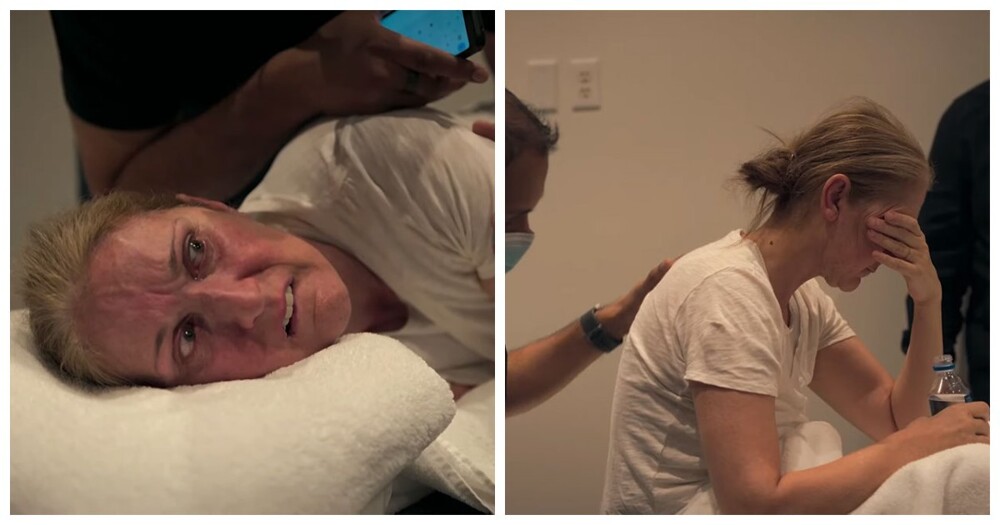
Tears slid freely down Céline’s face now — unguarded, unpolished. She stepped back from the microphone, breathing slowly, as if steadying herself against a memory she had kept private for decades.
“That night,” she said quietly, “I wasn’t singing to be brave.”
She looked out at the audience, then back to the man.
“I was singing so I wouldn’t fall apart.”
The orchestra waited, frozen.
“That song,” Céline continued, “was never finished. I couldn’t finish it.”
She turned toward the band.
“Can we start again?” she asked.
The pianist nodded.
Céline looked back at the man.
“Will you come up here?” she said gently. “Please.”
The audience rose before he could respond, applause carrying him forward as if the room itself were guiding him to the stage. He stood beside Céline — not as a spotlight-seeker, but as a witness.
“This version,” Céline said into the microphone, her voice steadier now, “has only ever existed in my heart.”
She began again.
The melody was the same, but the words were different.
Where there had once been longing, there was gratitude. Where there had been hope, there was acceptance. The final verse no longer reached outward — it turned inward, intimate and bare.
Céline sang not to the audience, but past them — back to a hospital room, to a bedside, to a moment when love meant staying even when there was nothing left to fix.
Her voice wavered, then strengthened, as if finally allowed to tell the truth.
The man beside her didn’t sing. He didn’t need to. His presence was enough.
When the final line faded, Céline didn’t hold the note. She let it fall naturally into silence.
No one clapped.
No one moved.
Somewhere in the darkness, a quiet sob escaped. Then another. The hall breathed together — thousands of people suddenly aware they had just been invited into something deeply personal.
Céline turned to the man and took his hands.
“Thank you,” she said simply.
He nodded, unable to speak.
As he returned to his seat, Céline faced the audience once more.
“Sometimes,” she said, her voice calm but resolute, “we think songs belong to us because we love them.”
She paused.
“But sometimes,” she added, “they belong to moments we were never meant to see.”
The concert continued, but nothing afterward felt the same. The applause was softer. The pacing slower. Céline sang as if every lyric carried a hidden room behind it — and tonight, one of those doors had finally been opened.
By morning, stories of the moment spread quietly across Paris. No headlines screamed. No clips captured everything.
But those who were there knew.
They hadn’t just heard a love song.
They had heard a goodbye — finally spoken out loud.
And in that shared understanding, Céline Dion reminded the world that the most powerful music is not written for fame, or for applause…
But for the moments that change us — even when we think no one is listening.